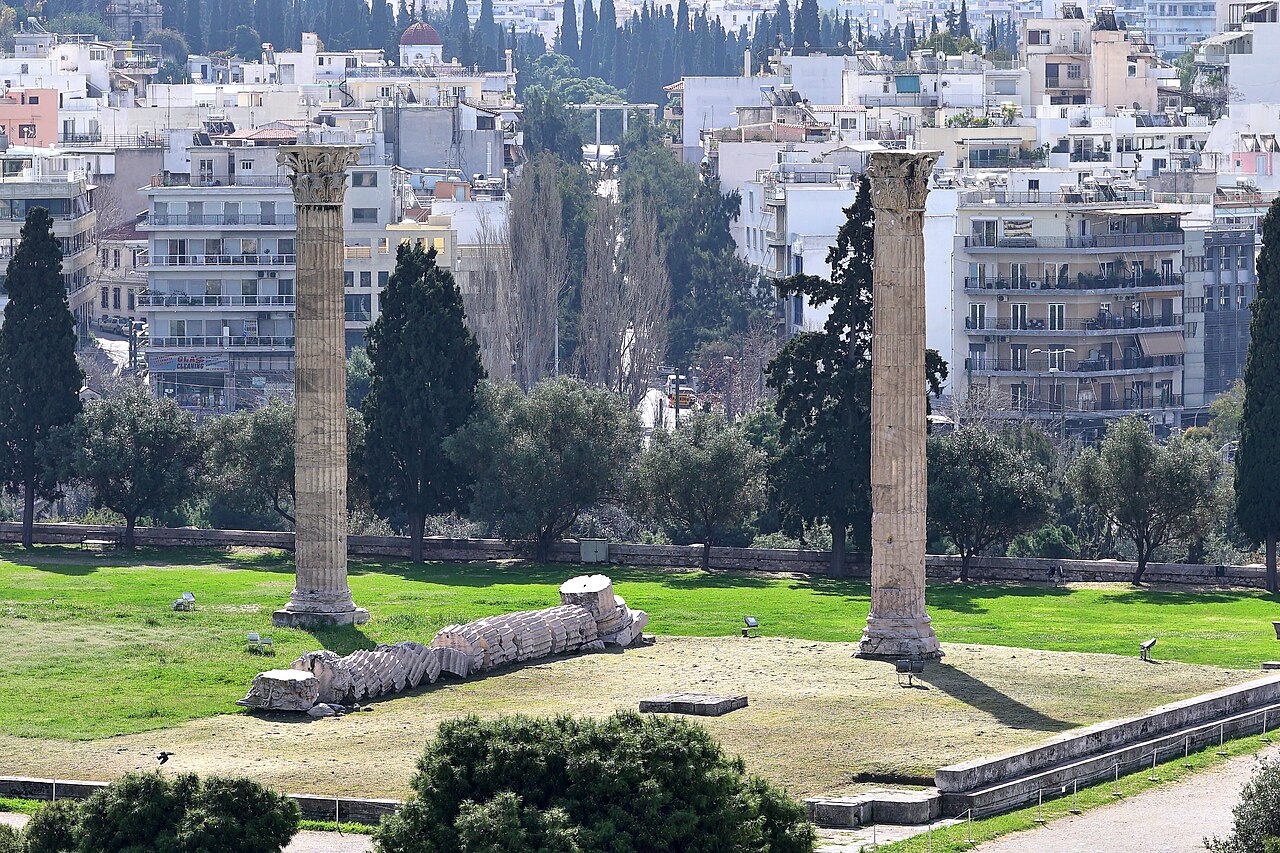
Fifteen Corinthian columns and one that fell in 1852, a short walk from Syntagma. How the audio guide works, the single entrance and what to see.
Tickets and tours
Which ticket to buy
Temple of Olympian Zeus Entry with Audio Guide
★ 4.7 (9,166)
Entry with an audio guide and an entry time you choose. Fifteen standing columns and one that fell in 1852 do not explain themselves, and there is almost nothing on site that does.
This is where the site is good value: bundled with the Acropolis and four other archaeological sites over three consecutive days. On its own it is a short visit for a full price.
Temple of Olympian Zeus tickets: fifteen columns, €26 with an audio guide, and when it is worth it
Temple of Olympian Zeus tickets are the easiest purchase in central Athens, and the site itself is small: fifteen standing columns on an open lawn, the queue is usually a handful of people, and most visitors are back on the pavement within the hour. What €26 on Headout buys instead is the audio guide, the booked entry time and an English booking flow that puts a mobile ticket in your inbox before you leave home. Whether those three things are worth it depends on how much you want to understand what you are looking at, because fifteen enormous Corinthian columns and a fallen sixteenth do not explain themselves.
Two things to know before you pay: at the time of writing there is restoration work on some of the columns, and avenue works have closed off the area around Hadrian's Arch. In winter the gate closes at 3 pm. The site also sits eight minutes east of the Acropolis South Slope, which is how most people reach it.
Guided tour or plain ticket?
Plain ticket. Neither Headout nor GetYourGuide sells a guided tour of the Temple of Olympian Zeus on its own at the time of writing, and the site does not need one: it is a flat, open, fenced area of about fifteen acres with one gigantic ruin in the middle and a scatter of lower foundations around it. What you need is context, and context here comes from a smartphone. The lead product on this page is the Headout Temple of Olympian Zeus Tickets with Audio Guide from €26: an entry ticket for the date and time you choose, a multilingual audio guide in the app (English, Spanish, German, Italian and Chinese on the English page) and the booking fee. It is rated 4.7 from more than 9,000 reviews at the time of writing, and once you are in you stay as long as you like.
Be clear about what you are paying for. The Headout ticket from €26 buys a booked slot and the commentary, which is what makes 20 minutes of standing columns readable. This site rarely has a queue worth skipping. The ticket also cannot be cancelled or rescheduled once booked, so it is a purchase for a fixed date. The two other single tickets in the table below are non-refundable and lower rated than the Headout product, which is why Headout leads here.
There is also a free alternative to the paid audio. The Ministry has announced a free Digital Tour Guide app for the site, available to the public from March 2026, with nineteen small marble plaques carrying QR codes installed around the grounds. If you are happy to download an app on arrival and read as you walk, that app is the cheapest narrated visit. If you would rather have everything arranged in one place before you land, the Headout ticket does that.
Tickets and prices
Partner prices are a snapshot from September 2026 and can move by a euro or two. The partner page shows the live figure before you pay. Every ticket, official or partner, covers the whole fenced Olympieion site: the temple, the Roman baths, the smaller temples and the stretch of city wall. One ticket, one gate.
Ticket
Price
Includes
Temple of Olympian Zeus tickets with audio guide
from €26
Entry at your chosen date and time, multilingual app audio guide, service fee. Stay as long as you like. Cannot be cancelled or rescheduled
Athens Multipass: Acropolis and 5 archaeological sites with audio guide
from €135
One entry each to the Acropolis (timed slot), the Ancient Agora and its museum, the Roman Agora, the Temple of Olympian Zeus, Aristotle's Lyceum and the Panathenaic Stadium, valid 3 consecutive days from first use. Audio tours for the Acropolis, Parthenon, Ancient Agora and Plaka. Cannot be cancelled
Timed e-ticket valid in your slot or 15 minutes either side, date and slot cannot be changed. Includes a Plaka audio walk, not a guide to the temple. Non-refundable. Lower rated
The reduced ticket is narrower than most visitors assume. Under the Ministry's current rules it goes to EU citizens over 65 from 1 October to 31 May, to parents accompanying EU primary-school visits, and to escorting teachers of school groups from outside the EU. Free entry is broader: EU citizens up to 25, children up to 18 from non-EU countries, visitors with a 67 per cent disability plus one escort, EU school groups, ICOM and ICOMOS members, licensed guides and journalists, all on presentation of ID or the relevant card on arrival. None of these categories exists on the partner sites, where every ticket is adult price. A family of two adults and two EU students should therefore book two Headout tickets and let the students walk in free.
Free days apply to everyone: 6 March, 18 April, 18 May, the last weekend of September, 28 October, and the first and third Sunday of each month from 1 November to 31 March. On those days a partner ticket buys you nothing but the audio guide, so check the date before you book. The site is a single ticket however you come to it. There is no separate museum, and nothing else to add.
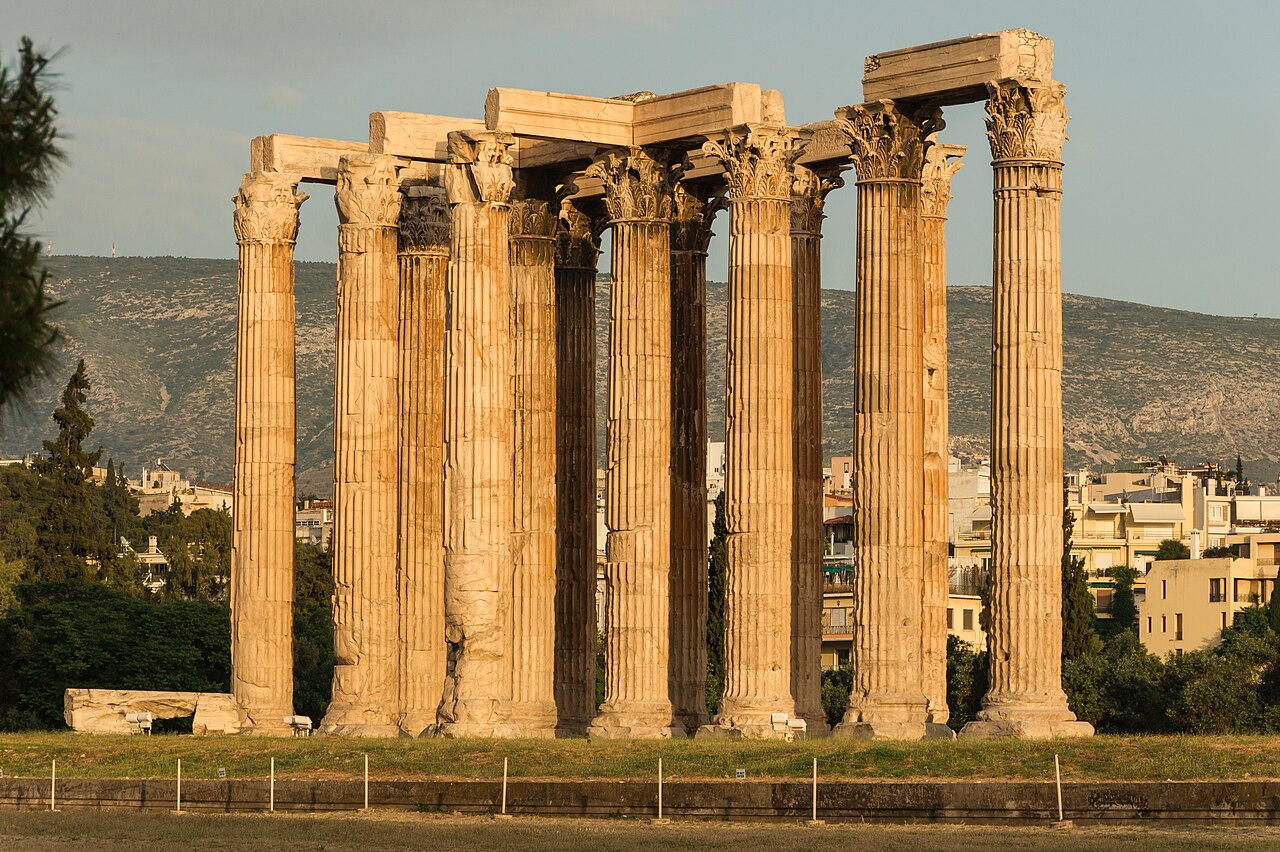
Photo: Jebulon / Wikimedia Commons
Opening hours and best time to visit
The Olympieion opens at 8 am every day. There is no weekly closing day. In summer it closes at 8 pm with last entry at 7.30 pm. From September the closing time steps down every fortnight, as posted by the Ministry: 1 to 15 September 8 am to 7.30 pm (last entry 7.10 pm), 16 to 30 September 8 am to 7 pm (last entry 6.40 pm), 1 to 15 October 8 am to 6.30 pm (last entry 6.10 pm), and 16 to 30 October 8 am to 6 pm (last entry 5.40 pm). The winter timetable is 8 am to 3 pm with last entry at 2.40 pm. The Ministry does not print the dates on which summer hours resume in spring, so treat late March and early April as a check-before-you-go period.
Closed days are 1 January, 25 March, 1 May, Orthodox Easter Sunday, 25 December and 26 December. On Orthodox Good Friday the site opens from noon to 5 pm and on Holy Saturday from 8.30 am to 3.30 pm. At the time of writing the Parilissia Sanctuaries, the southern section of the unified site along the Ilissos, cannot be visited, and restoration work by the Ephorate of Antiquities is in progress on the temple, so some columns may be behind scaffolding. Neither has a published end date.
The best time is a question of light and heat rather than crowds. The columns stand in the open with no shade at all, on pale ground that throws the sun back at you, so in July and August the first hour after 8 am or the last hour before closing are the comfortable ones. A 7 pm entry in high summer gives you low light on the marble and the site nearly to yourself. In winter this is a morning visit by definition: last entry is 2.40 pm and the gate closes at 3 pm, which catches people who arrive after a long lunch in Plaka. There is no official figure for how long to allow. Our advice is about 45 minutes to an hour, and most people are done sooner. That makes it a natural first or last stop on a day built around something bigger.
Getting there
The address is Vasilissis Olgas Avenue, Athens, and the only public entrance is the gate house on that avenue, on the north side of the site. The site's telephone number is +30 210 9226330. Ignore any other address on your booking. Headout's page gives a redemption point on Athanasiou Diakou, which is the street along the southern boundary, but the Ministry is explicit that the Vasilissis Olgas gate is the single way in, so walk to that gate and show your mobile ticket there. Works on the avenue in front of the entrance began in August 2025 and the Ministry says they do not obstruct access to the site. The area around Hadrian's Arch at the western corner, however, is closed to the public for the same redevelopment at the time of writing.
The nearest metro is Akropoli on Line 2, about five minutes on foot. All walking minutes on this page are map estimates, not official figures. Syntagma Square is roughly ten minutes north along Amalias Avenue. Buses and the tram also serve the avenue, and the site sits at the corner where Amalias meets Vasilissis Olgas, so it is hard to miss: the columns are visible from the street well before you reach the gate.
On foot from the neighbours: the Acropolis Museum is about five minutes west along the same pavement, which is why the two make such a comfortable pairing. The south-slope entrance of the Acropolis is about seven minutes, and the main west entrance closer to twelve. The Panathenaic Stadium is about ten to twelve minutes east along Vasilissis Olgas. The Benaki Museum is about nine minutes to the north-east, and the Ancient Agora about twenty minutes across Plaka.
What to see: highlights
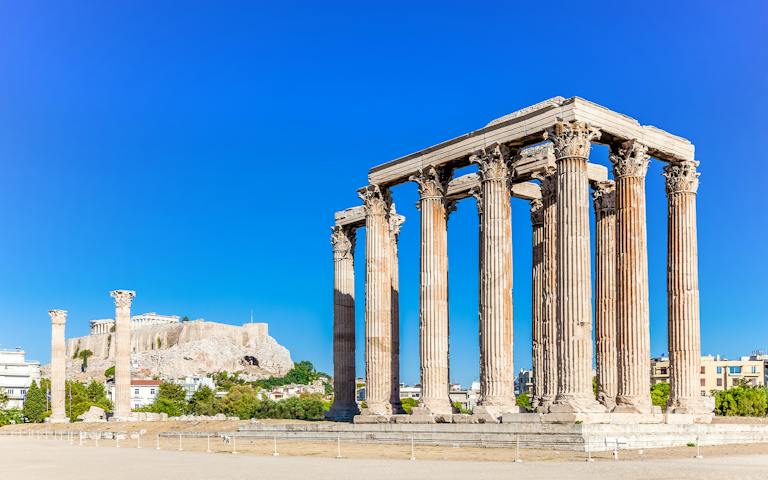
The columns. Sixteen of the temple's Corinthian columns survive: fifteen stand, thirteen of them in the tight group at the east end and two at the west end, and the sixteenth lies where it fell in 1852, its drums spread across the ground in a line. The fallen one is the best place to grasp the scale, because you can stand beside a single drum and measure yourself against it.
The plan and the builders. The Ministry describes the complete building as three rows of eight columns on each short side and two rows of twenty along each long side. Vitruvius counted it among the most famous marble buildings ever built. Peisistratos the Younger began it in 515 BC, it was abandoned when the tyranny fell, the Seleucid king Antiochos IV Epiphanes resumed it in 174 BC, and it was finished under the emperor Hadrian in the second century AD, the Ministry dating the completion to the years between AD 124 and 132. Hadrian took the title Olympios, and the temple held a gold-and-ivory statue of Zeus and a statue of the emperor himself.
Hadrian's Arch. Just outside the fence at the Amalias corner, free to see from the street and the marker of where Hadrian's new quarter of the city began. At the time of writing the area around it is closed off for the avenue works, so photograph it from across the road rather than planning to walk beneath it.
The Roman baths and the Classical houses. A Roman bath complex, the balaneion, and the foundations of Classical-period houses lie inside the fence, easy to walk past if you make straight for the columns and worth the detour on the way out.
The smaller temples. The small peripteral temple of Kronos and Rhea from 150 BC, the Doric temple of Apollo Delphinios and the Delphinion Court of around 500 BC, and the temple of Panhellenic Zeus of AD 131 to 132, all named by the Ministry within the site, show that this ground was sacred long before Hadrian.
The basilica and the city wall. A basilica of the fifth century AD and the gates of the Themistoclean wall of 479 to 478 BC bracket the temple in time, one from before Zeus had a roof here and one from after the cult had gone.
Photo: George E. Koronaios / Wikimedia Commons
Tips before you go
Rules first: the Ministry forbids food, drink, smoking and litter inside the fence, asks you not to touch or climb on the monuments, to keep to the marked routes and away from any area where works are in progress, and recommends proper walking footwear, because the ground is gravel and uneven stone. There is no shade, so wear a hat from May to September and drink before you go in. Toilets, including an accessible one, and a gift shop are on site.
Accessibility is good for an archaeological site. The Ministry says the largest part of the site is wheelchair accessible through the main entrance on Vasilissis Olgas, with assistance from a companion recommended. There are accessible toilets, and tactile site plans and Braille brochures in Greek and English are kept at the entrance. Follow the Ministry on this rather than the partner page, which is more cautious. Reduced and free tickets are issued only against documents, so carry ID, and if anyone in your group qualifies, let that person sort their ticket out on arrival rather than online.
One plan: arrive at the Vasilissis Olgas gate at 8 am, walk straight to the columns while the light is low and the ground is cool, circle the fallen column, then take the outer path past the baths, the small temples and the wall before the sun is high. Photograph Hadrian's Arch from the Amalias pavement on the way out. You will be done by 9 am with the whole day ahead of you and the Acropolis Museum five minutes away.
How to book, in four steps
Decide gate or app. Skip the audio only if anyone in your group qualifies for free or reduced entry, which is checked against ID on arrival. €26 on Headout if you want the audio guide, a booked time and a mobile ticket ready before you fly.
Pick the slot. 8 am in any season, for the light and the temperature. From September, check the last-entry time for your fortnight. Once the winter timetable is in force, mornings only, because the gate shuts at 3 pm. Skip the online ticket on a free day.
Book only when the date is fixed. Temple of Olympian Zeus tickets from Headout cannot be cancelled or rescheduled. Buy it for a settled itinerary.
Pair it with a neighbour. Five minutes to the Acropolis Museum, ten to twelve to the Panathenaic Stadium, and the Acropolis itself just beyond the museum, so three sites fit into one morning along one pavement.
Nearby and combinations
The temple is small enough that it should never anchor a day, and close enough to the big sites that it never needs to. The obvious partner is the Acropolis Museum five minutes west. The Acropolis itself follows, and our Acropolis tickets page explains why the early slot on the rock is the one to protect, which in practice means Acropolis first, museum second, and the columns as a late-afternoon addition in summer when the site is open until 8 pm. In winter, reverse it: columns at 8 am, then the museum, then the rock.
Passes need reading carefully here. The Temple of Olympian Zeus is one of the six sites in the Headout Multipass from €135, valid for three consecutive days, alongside the Acropolis, the Ancient Agora with its museum, the Roman Agora, Aristotle's Lyceum and the Panathenaic Stadium. It pays if you were going to buy the Acropolis ticket anyway and want at least two of the smaller sites on top of it. It is not in the Turbopass Athens City Pass at the time of writing, and not in the Headout MegaPass, so if you have read somewhere that "the pass covers the temple", check which pass. Our Athens City Pass page compares them.
For a bigger site nearby, our Ancient Agora tickets page covers the Agora and its museum, about twenty minutes away on foot, and the two together make a good day for anyone who found the Acropolis too crowded to enjoy. Temple of Olympian Zeus tickets are the quick, cheap end of the Athens list: under an hour on site and one small decision.
How much is a ticket for the Temple of Olympian Zeus?+
Partner tickets with an audio guide start around €26, and the site sits inside the Athens Multipass with the Acropolis and four more sites from €135. A reduced rate applies to EU seniors over 65 from 1 October to 31 May, and EU citizens up to 25 and non-EU children up to 18 enter free with ID.
Is the Temple of Olympian Zeus worth a stop?+
On its own it is a short visit, about 20 to 30 minutes. It makes much better sense inside the Athens Multipass, which bundles it with the Acropolis and four other sites, or as an eight-minute walk east from the Acropolis South Slope at the end of a day.
What is left of the Temple of Olympian Zeus?+
Fifteen standing Corinthian columns, thirteen in the eastern group and two at the west end, plus one that fell in a storm in 1852 and still lies where it landed, split into its drums. The original plan ran 3 by 8 columns on the short sides and 2 by 20 on the long ones.
Why did the Temple of Olympian Zeus take so long to build?+
About 640 years, across three attempts. Peisistratos the Younger began it in 515 BC, Antiochos IV Epiphanes resumed the work in 174 BC, and the emperor Hadrian finished it in the 120s AD and took the title Olympios for doing so. It housed a gold-and-ivory statue of Zeus.
What time does the Temple of Olympian Zeus open?+
08:00 every day. It closes at 20:00 in summer with last entry at 19:30, and at 15:00 in winter with last entry at 14:40, stepping down through September and October in between. It closes on 1 January, 25 March, 1 May, Orthodox Easter Sunday, 25 December and 26 December.
Where is the entrance to the Temple of Olympian Zeus?+
The gate house on Vasilissis Olgas Avenue is the only way in. Akropoli station on Line 2 is about five minutes away, and Hadrian's Arch stands at the corner of the site, outside the fence, so you can see that without a ticket.
Fifteen columns, and one that fell in 1852.
Begun in 515 BC, finished by Hadrian. Best bought inside the Multipass, or walked to from the Acropolis South Slope.