Athens Museums / Best museums in Athens / Museum of Cycladic Art
Museum of Cycladic Art Athens
Cycladic figurines, ancient Greek art and the Stathatos Mansion on Vasilissis Sofias. What to see, how long it takes and how to plan the visit.
Tickets and tours
Which ticket to buy
Every price links straight to secure checkout on GetYourGuide. Prices are a snapshot, not a live feed.
We may earn a commission when you book through these links, at no extra cost to you.
Museum of Cycladic Art Athens: where Greek art begins, on Vasilissis Sofias
The Museum of Cycladic Art is entered through the Stathatos Mansion on Vasilissis Sofias Avenue. GetYourGuide sells a plain entry ticket from €12, valid for one day, with free cancellation and a 4.6 rating from 81 reviews; Headout has never had a working listing for this museum. No Athens pass includes the Museum of Cycladic Art. The real question is whether an afternoon among five-thousand-year-old marble figurines is worth the walk up Vasilissis Sofias, and the answer is yes if the Acropolis has left you wanting to see where Greek art began.
Come on a weekday morning or a Thursday evening, allow about two hours, go straight to the Cycladic figurines on the first floor, and pair the visit with the Byzantine and Christian Museum or the Benaki, both a few minutes away on the same avenue.
Guided tour or plain ticket?
There is no partner guided tour to compare here. The plain ticket is GetYourGuide's permanent-collections entry ticket, from €12 with free cancellation and a 4.6 rating from 81 reviews. Headout has twice listed a ticket for this museum and twice marked it unavailable, so it has never been a live option here. The Athens passes do not list this museum, so it stays a stop of its own.
The collection suits a plain visit anyway. The Museum of Cycladic Art is a compact private museum on four floors, arranged by theme, with clear labels and its own visitor-guide app carrying audio tours of every permanent gallery. The Cycladic figurines on the first floor are the reason most people come, and they reward slow looking more than commentary: pale marble figures with folded arms and tilted heads, carved five thousand years ago, that look startlingly modern. If you do want someone to talk you round, the museum runs its own English-language tour on Mondays at 12:00, covering the Jeff Koons show in the Stathatos Mansion and the permanent galleries, booked on site rather than through a partner, and only until 28 September 2026 when the Koons exhibition closes. For a plain visit, the GetYourGuide ticket is the simple way in.
Tickets and prices
Museum of Cycladic Art Athens prices below are the museum's own published figures as of September 2026.
| Ticket | Price | Includes | |
|---|---|---|---|
| General admission (on site) | from €12 | Permanent exhibitions on four floors. E-ticket and card payment recommended by the museum | Book |
Entry is free for children under 18, for visitors with disabilities and one companion, for Cycladic Friends members, archaeology and art-history students, ICOM and ICOMOS members, journalists, licensed tour guides and Greek citizens holding a current unemployment card. Documentation is checked at the entrance, so a family with teenagers or a couple over 65 should bring ID for the reduced or free tariff. These categories have no online route to apply them to without a partner ticket in place.
There are no free days. This is a private foundation museum, so the Ministry of Culture list of free-entry dates that applies to the state museums and archaeological sites does not apply here, and neither does the first-Sunday-in-winter rule. The museum is also not part of the Athens City Pass, the Flex Pass or the Headout MegaPass: none of the three lists it among its attractions. At €12 that hardly matters, but it does mean neither a pass nor a partner ticket gets you past the desk right now.
Opening hours and best time to visit
The Museum of Cycladic Art Athens keeps one timetable all year, with no summer and winter split. It opens Monday, Wednesday, Friday and Saturday from 10:00 to 17:00, Thursday from 10:00 to 20:00, and Sunday from 11:00 to 17:00. Tuesday is the weekly closing day. Last entry is 15 minutes before closing, so 16:45 on most days and 19:45 on Thursdays. The Cycladic Shop and the Cycladic Cafe follow the same hours.
The museum also closes on 1 January, Clean Monday, 25 March, Orthodox Easter Sunday and Easter Monday, 1 May, Holy Spirit Monday, 15 August, and 25 and 26 December. Two details catch travellers out every year: Tuesday, because most Athens museums are open then and it is natural to assume this one is too, and the Sunday late start at 11:00.
The quiet slot is Thursday evening. The 20:00 closing is the only late opening in the week, the last entry at 19:45 gives you a comfortable two hours from 17:30 or so, and the Kolonaki streets outside are at their best for dinner afterwards. Otherwise go for the first hour after opening on a weekday. Arriving early only buys comfort. Peak season matters less here than at the big sites, although the Koons show in the Stathatos Mansion adds visitors of its own until it closes in late September 2026.
How long to allow: the museum gives no figure. Visitors commonly report one and a half to two hours for the permanent exhibitions, and two hours is a fair plan that leaves room for the cafe. Add half an hour if you take in the temporary show as well.
Getting there
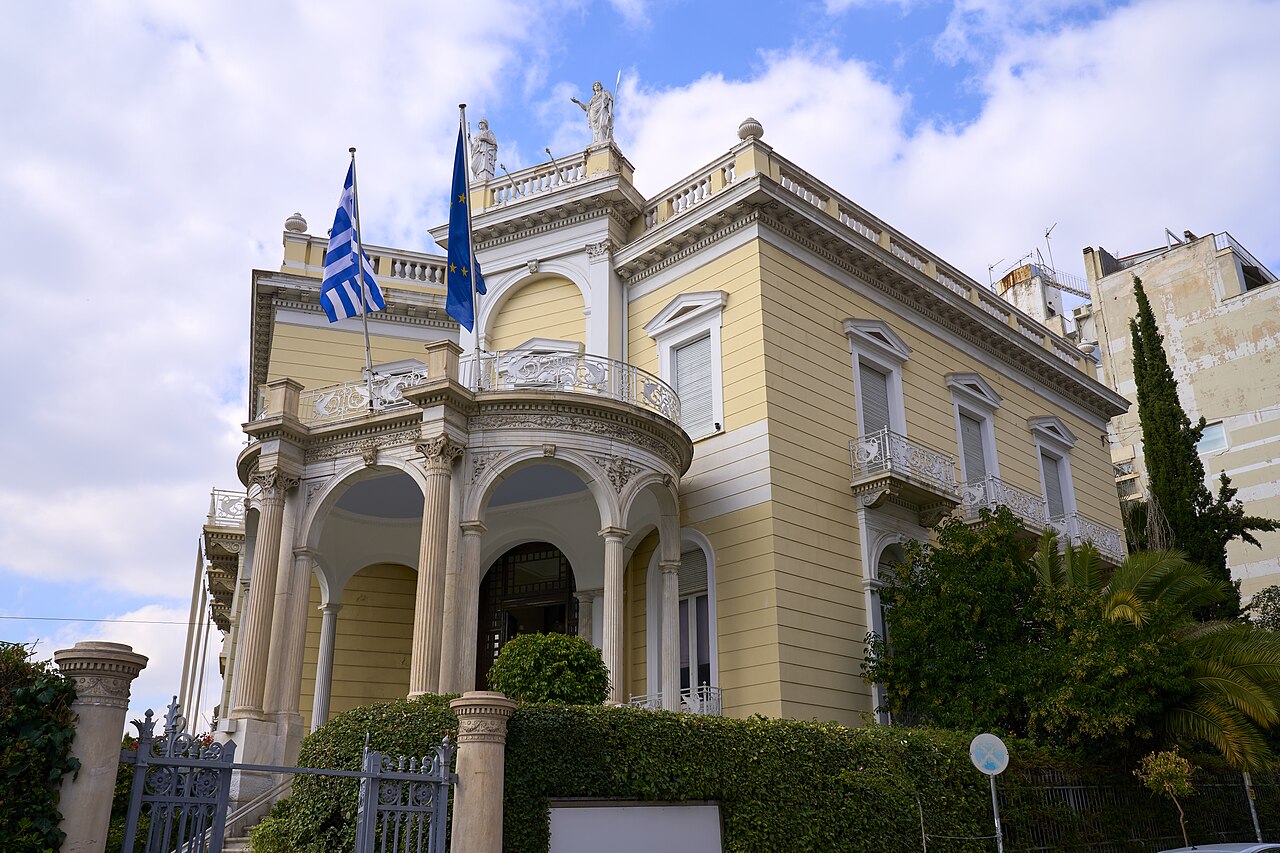
The museum's main building stands at 4 Neophytou Douka Street in Kolonaki, a quiet side street off Vasilissis Sofias Avenue. During the current renovation, however, that entrance is under construction and visitors are welcomed through the Stathatos Mansion instead, on the corner of Vasilissis Sofias Avenue and 1 Irodotou Street. The two buildings are joined inside by a corridor, so you still reach every gallery. You just start in the neoclassical mansion rather than the modern block.
By metro, Evangelismos on Line 3 is 500 metres away, and Syntagma on Lines 2 and 3 is 600 metres, which the museum puts at ten minutes on foot from Syntagma Square along Vasilissis Sofias. From Filikis Etairias Square in central Kolonaki it is three minutes. Buses and trolleybuses stop at Rigilis, immediately across the avenue, on lines including 3, 203, 211, 214, 220, 221, 224, 235, 608, 622, 815, A5, E14 and X95. From the Acropolis it is roughly two kilometres, about 25 to 30 minutes on foot via Syntagma by our own map estimate. The museum publishes no figure.
Do not drive. There is no car park, only a temporary drop-off in front of 4 Neophytou Douka, and the nearest private car parks are at Ipsilantou 20, Rizari 4, Karneadou 25 and Filikis Etaireias Square 14. The neighbours are closer than any of them: the Byzantine and Christian Museum is four minutes on foot along the avenue, the Benaki Museum's main building about seven, and the Goulandris Foundation with its Van Gogh and Picasso is ten minutes up into Pangrati.
What to see: highlights
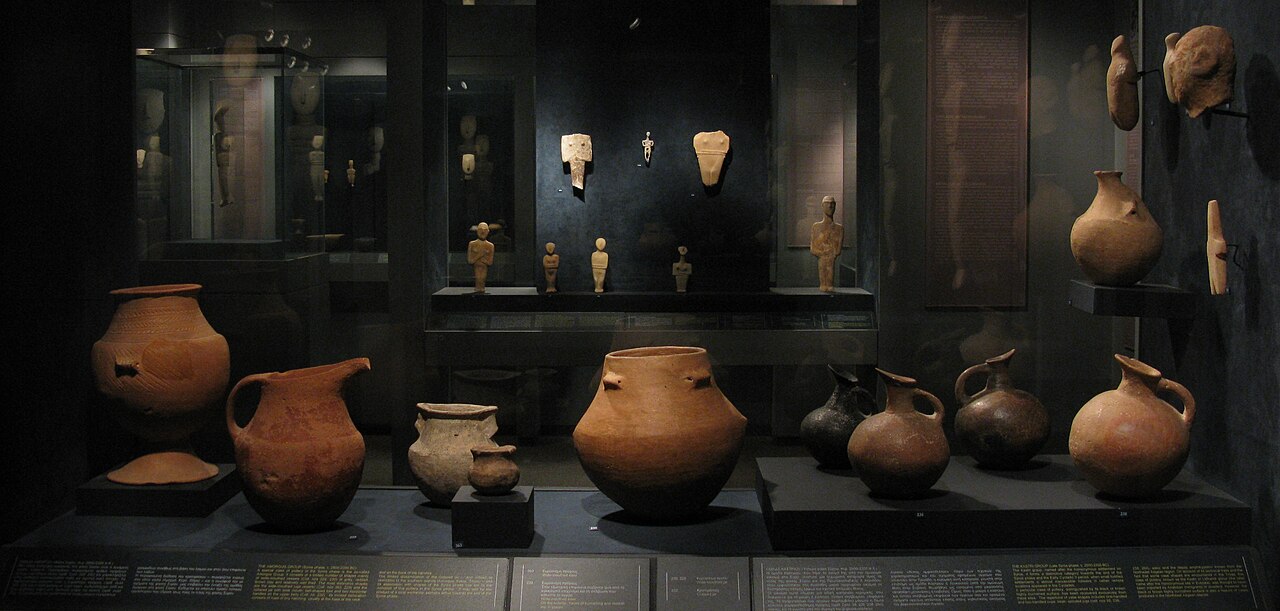
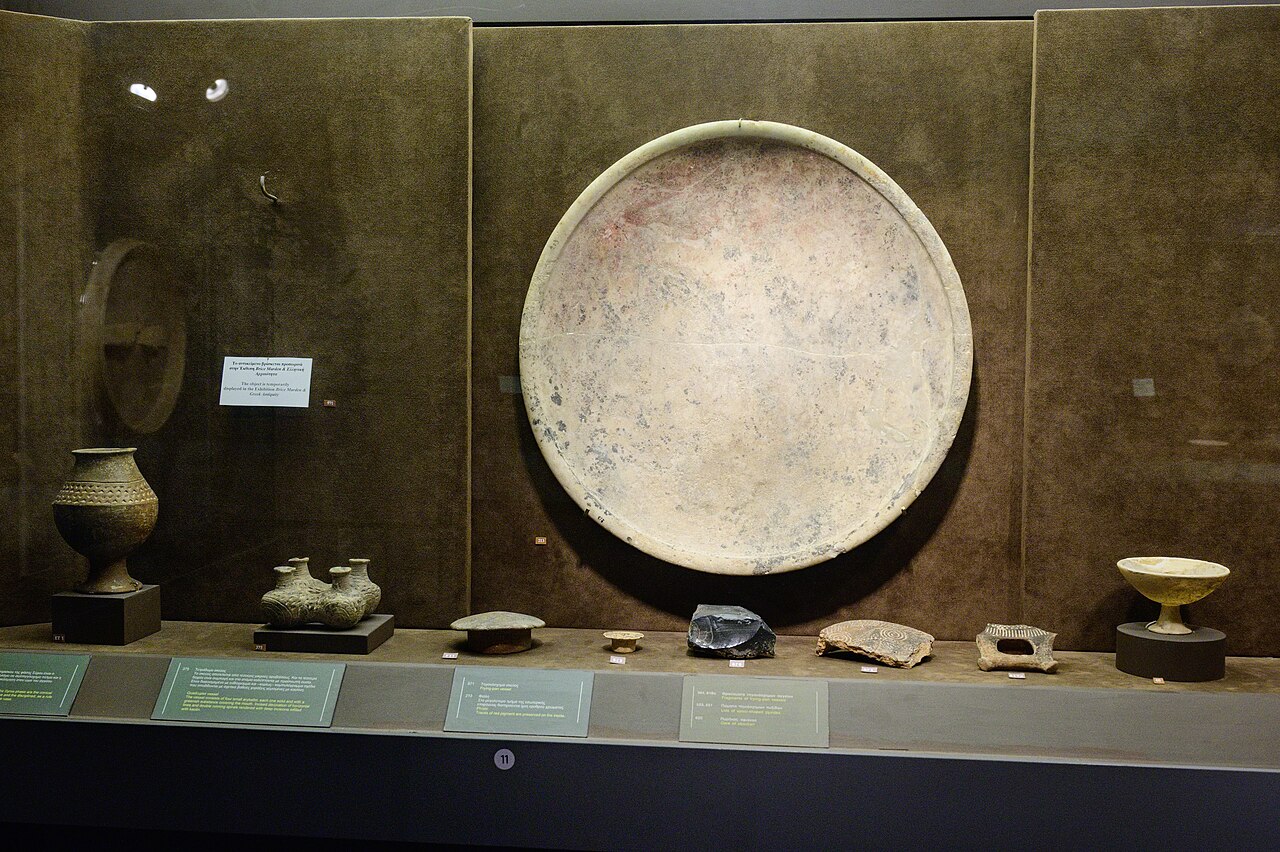
- Cycladic Art, first floor. The core of the museum: Early Cycladic culture of the third millennium BC, objects dated 3200 to 2300 BC, most of them marble figurines of naked female figures that begin schematic and grow more naturalistic. Look for the piece known as the cup bearer, a canonical female figurine of the Dokathismata variety, a marble collared jar known as a kandila, a clay frying-pan vessel and the group known as the Keros Hoard. Bronze tools and weapons and clay vessels fill in the daily life behind the figures.
- Ancient Greek Art: A history in images, second floor. About 400 objects from 2000 BC to the fourth century AD, arranged as a history of Aegean societies from the first city-states through democracy to empire, with interactive screens. The named pieces are a lidded pyxis of 760 to 750 BC, a marble statue of a boy holding a hare and a marble statuette of Aphrodite, both from around 320 to 310 BC, and a bronze Corinthian helmet of the seventh century BC.
- Ancient Cypriot Art, third floor. The Thanos N. Zintilis Collection, running from the fourth millennium BC to medieval times: figurines, sculpture, inscriptions, bronzes, coins, jewellery and ten showcases of pottery, grouped by worship, weaving, perfumery, burial customs, writing, metalwork, coinage and seals. A stone figurine of 3900 to 2500 BC, a double-necked jug, a limestone bust of a bearded man from the early sixth century BC and a gold necklace with precious stones from around 350 AD are the anchors.
- Scenes from daily life in antiquity, fourth floor. 142 objects from the permanent collections in seven large showcases, mostly fifth to first century BC, grouped into nine themes: gods, heroes and Eros, the lives of women, men at home, at the symposium, the gymnasium, the agora and at war, religion and the Underworld. Two short films follow a fictional Athenian named Leon from birth to burial. This is the floor that makes the rest of the museum legible, and a good one to see with children.
- The Stathatos Mansion. Built in 1895 for Othon and Athina Stathatos to a design by Ernst Ziller, owned by the family until 1938, later home to foreign diplomatic missions, bought by the Greek state in 1982 and granted to the museum in 1991. One of the most important surviving pieces of 19th-century neoclassical architecture in Athens, it hosts the temporary exhibitions and, for now, is where you come in. Until 28 September 2026 it holds Jeff Koons' Balloon Venus Lespugue (Orange) alongside ten certified copies of Palaeolithic Venus figurines from European museums, on a separate ticket.
- The Cycladic Cafe. In the indoor garden of the main building, under a floating sculptural ceiling by Stelios Kois, open the same hours as the museum and, like the shop, accessible without a ticket. Breakfast, brunch, lunch, coffee and Greek wines, and the natural pause between the second and third floors.
The main building itself is worth a glance: designed in 1985 by the architect Ioannis Vikelas, with four floors and 2,300 square metres of exhibition space, and extended in 2007 with a New Wing for temporary shows and the education department.
Tips before you go
Handbags can come into the galleries. Backpacks and small luggage go into the lockers provided. Photography without flash or tripod is allowed for personal use, but video and any kind of recording are not, so leave the camera on stills. Phones on silent, no smoking or e-cigarettes, and no food or drink outside the Cycladic Cafe, including your own. The museum recommends electronic tickets and card payment.
Access is good. There is a wheelchair ramp at the Stathatos Mansion entrance, two stair lifts into the mansion, lifts to every floor of the main building, two wheelchairs on free loan at the entrance and accessible toilets on level -1 and on the fourth floor. Visitors with sensory or motor difficulties and their companions enter free on showing documentation. Guide and assistance dogs are welcome everywhere. Other pets are not. The museum's visitor-guide app carries audio tours of all four permanent exhibitions plus navigation, so download it on the museum WiFi once you are inside.
In summer this is a good museum for the afternoon heat: four cool, compact floors, a shaded atrium cafe and a ten-minute walk back to Syntagma when you are done. In winter the Thursday evening slot is even better, because the Kolonaki cafes and restaurants around Filikis Etairias Square are two streets away.
One plan: walk up Vasilissis Sofias from Syntagma on a Wednesday or Friday morning, or a Thursday around 17:30 for the late opening, enter through the Stathatos Mansion door on Irodotou Street, and go straight to the Cycladic figurines on the first floor while you are fresh. Work up through Ancient Greek and Cypriot art, finish with the daily-life floor, and take coffee in the atrium. If the Koons show is still running, add that ticket at the same desk on the way in.
How to book, in four steps
- Book the plain ticket, unless you qualify for less. The GetYourGuide ticket starts from €12 with free cancellation. Reduced entry goes to over-65s, students and 19 to 25 year olds, and under-18s and several other categories enter free, all checked against ID at the museum.
- Decide about the Koons show separately. The temporary exhibition in the Stathatos Mansion is a separate ticket, or can be combined with the permanent collections, so work out before you queue whether you want both.
- Pick the day carefully. Never a Tuesday. Thursday is the only day the museum is open past 17:00, with last entry at 19:45, and Sunday opens an hour later than the rest of the week at 11:00.
- Pair it with a neighbour. The Byzantine and Christian Museum and the Benaki are both on the same avenue within seven minutes on foot, so one Kolonaki day covers five thousand years of Greek art without a second metro fare.
Nearby and combinations
The Museum of Cycladic Art Athens sits on the museum row along Vasilissis Sofias, which makes it the easiest of the private collections to combine even without a partner ticket to bundle. The nearest pairing is the Byzantine and Christian Museum, four minutes away along the avenue, and the most natural is the Benaki: our Benaki Museum tickets page covers its main building, seven minutes on foot, and how to plan the two together.
The Athens passes do not list this museum, so it stays a €12 stop of its own even if you are holding one for the Acropolis and the state museums. For the wider picture, our Best museums in Athens guide ranks the city's collections and suggests which ones pair well in a day. If your interest is the art rather than the antiquities, the Goulandris Foundation in Pangrati is the natural second stop, ten minutes on foot, and the National Gallery of Greece is nine minutes away on the same side of town.
Before you book
Frequently asked questions
What people ask before they book.
How much does it cost to visit the Museum of Cycladic Art?+
Tickets start from €12 on GetYourGuide, with free cancellation. A reduced rate applies to visitors aged 65 and over, students, those aged 19 to 25, Chamber of Fine Arts cardholders and groups of 12 or more. Entry is free for under-18s, disabled visitors plus a companion, Cycladic Friends and a handful of professional categories such as licensed guides and journalists.
What are the Museum of Cycladic Art's opening hours?+
The museum opens Monday, Wednesday, Friday and Saturday from 10:00 to 17:00, Thursday from 10:00 to 20:00 and Sunday from 11:00 to 17:00, with last entry 15 minutes before closing. These hours stay the same all year. It is closed on Tuesdays and on Greek public holidays including Clean Monday, Orthodox Easter and 25 December.
Is the Museum of Cycladic Art free on any day?+
No fixed free days are published. The Museum of Cycladic Art is a private museum, so the Ministry of Culture's free-admission calendar that applies to state sites does not cover it. Entry is free year round for under-18s, disabled visitors and a companion, Cycladic Friends, archaeology and art-history students, ICOM and ICOMOS members, journalists and licensed guides.
What is the Museum of Cycladic Art known for?+
It holds one of the world's largest collections of Cycladic marble figurines from the third millennium BC, displayed on the first floor alongside pieces such as the cup bearer. Other floors cover Ancient Greek and Cypriot art, including a marble Aphrodite and a 7th-century BC Corinthian helmet, plus a gallery on daily life in antiquity.
Where is the Museum of Cycladic Art and how do you reach it?+
The museum's main building is on Neophytou Douka Street in Kolonaki, though entry currently runs through the Stathatos Mansion on Vasilissis Sofias Avenue while the main building is under renovation. The nearest metro stops are Evangelismos on Line 3, about 500 metres away, and Syntagma on Lines 2 and 3, roughly a 10-minute walk.
Do I need to book a ticket for the Museum of Cycladic Art in advance?+
It is not essential, but GetYourGuide sells a plain entry ticket from €12, valid for one day with free cancellation, so you can fix the day in advance. If you qualify for the reduced rate, pay at the museum's own desk at the Stathatos Mansion entrance with ID.