The smallest temple on the hill, rebuilt three times, and the relief that is not there any more.
Tickets and tours
Which ticket to buy
Bestseller
Acropolis & Parthenon Guided Tour with Skip-the-Line Entry
★ 4.5 (9,110)
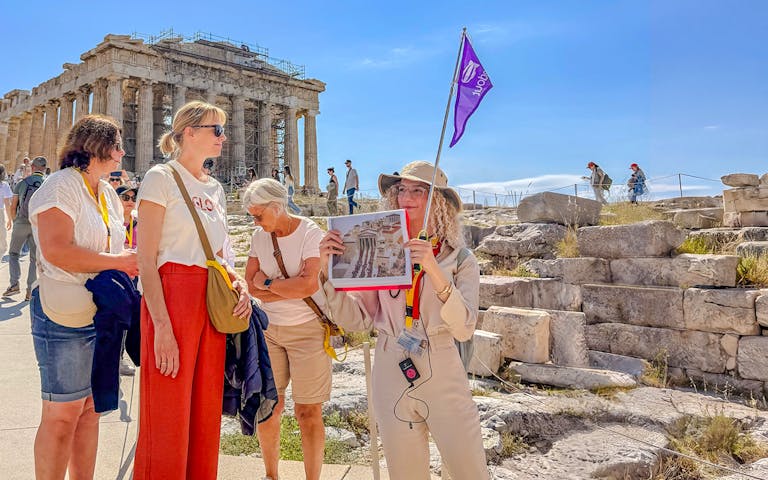
A live guide is the practical answer to this temple's biggest problem: it is easy to walk straight past. Two hours, timed entry included, and someone pointing out the bastion on the way up.
Temple of Athena Nike: the smallest building on the hill, rebuilt three times over
The Temple of Athena Nike is easy to walk past. It stands on a bastion just south-west of the Propylaia, small enough that most first-time visitors register it only as a detail on the way to the Parthenon. That undersells it: it is the only temple on the Acropolis that has been fully dismantled and rebuilt three separate times, and its most famous sculpture is not even on the building any more. Compared with the Parthenon further up the hill, or the Erechtheion with its Karyatid porch, it gets a fraction of the attention, which is part of why it deserves more than a passing glance.
This page covers what the small temple is, what happened to it over the centuries, and where to find the relief everyone remembers it for once you realise it is not there any more.
Built by the same architect as the Parthenon, around 420 BC
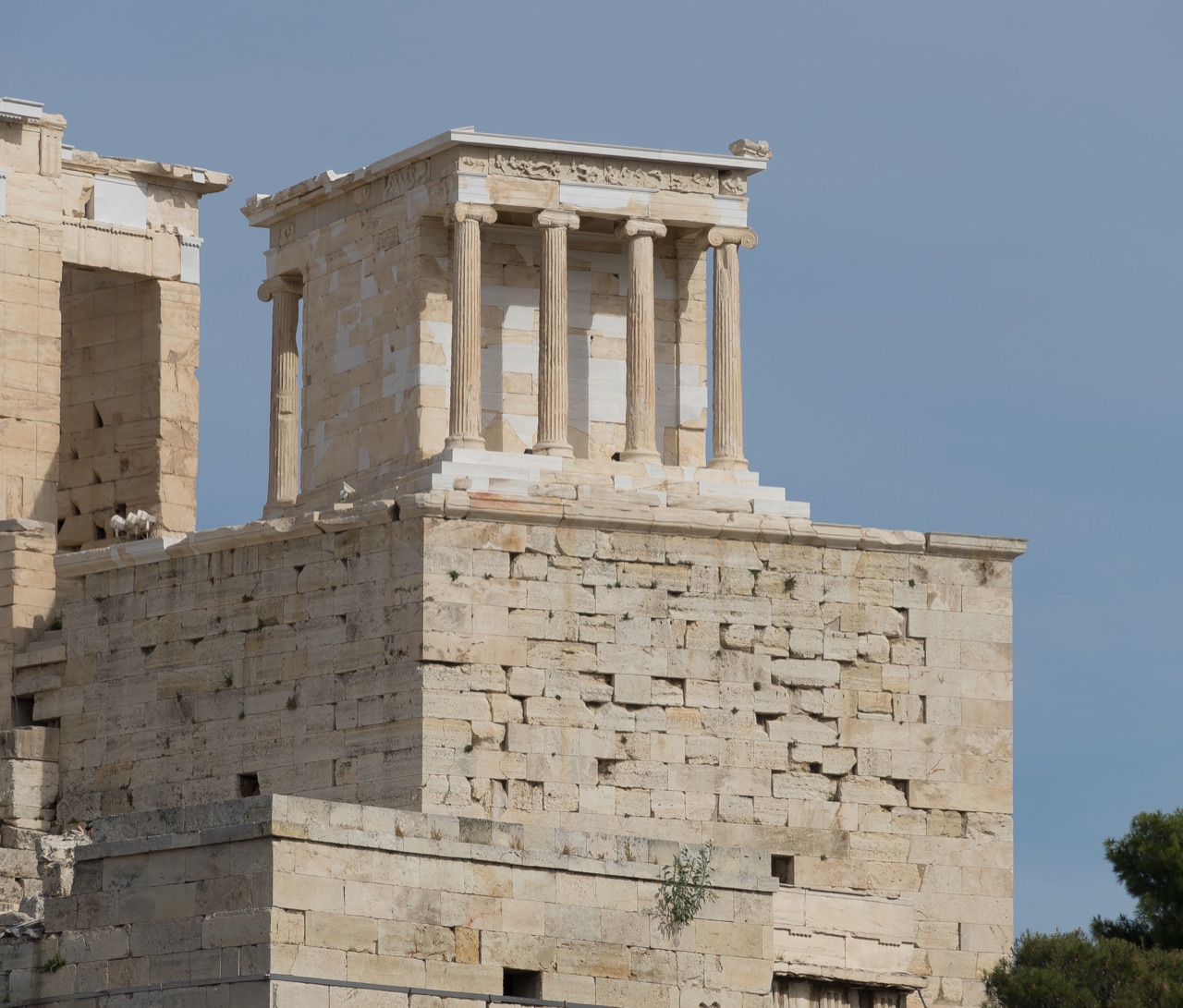
The temple was completed around 420 BC, part of the wider rebuilding of the Acropolis after the Persians had destroyed the earlier sanctuaries on the hill. The architect was Kallikrates, who also worked on the Parthenon, and the building he produced is deliberately different in character: a small, elegant Ionic temple to set against the grand Doric statement further up the rock, dedicated to Athena in her aspect as Nike, goddess of victory. The site on a projecting bastion was deliberate. From there it overlooks the approach to the Propylaia and the plain toward the sea, a natural place to associate the goddess of victory with a view of the city she was meant to protect.
Dismantled for a cannon platform, then rebuilt three times
In 1687, with the Venetian fleet threatening Athens, the Ottoman garrison dismantled the temple and its surrounding parapet and reused the stone to reinforce a gun emplacement on the same bastion, fortifying the western approach to the Acropolis. For a period the temple did not exist as a standing building; its marble was doing duty as a defensive wall.
The first reconstruction came in 1835 to 1836, under Ludwig Ross, the administrator of antiquities at the time, and counts as one of the earliest major Greek archaeological restorations of any Acropolis monument. Understanding of the original fabric kept improving, and the temple came down and went back up twice more: a second full reconstruction in 1940, and a third, the most recent, completed in 2010. Each cycle used more precise knowledge of where each block originally sat, which is why the temple standing today is considered a more accurate reconstruction than either of its predecessors, even though the physical stone is largely the same material moved and reset each time.
Photo: Jebulon / Wikimedia Commons
Why some guides call it "Wingless Victory"
You will sometimes hear the temple called Nike Apteros, wingless victory, and the explanation usually offered is a piece of local legend rather than a documented fact: that the Athenians deliberately left the cult statue of Nike without wings so that victory could never fly away from the city. Whether that story reflects the thinking of the people who commissioned the statue or was attached to it later is not something the surviving evidence settles either way, so treat it as a tradition worth knowing, and repeat it with that caveat. What is documented is the temple's role: a small Ionic shrine to Athena in her aspect as bringer of victory, sited so that anyone approaching the Acropolis saw it before anything else on the hill.
The Ionic order itself is part of what makes the building worth a second look. Everything else you pass on the way up, the Propylaia gatehouse, the Parthenon beyond it, is Doric, the plainer, heavier order associated with mainland Greek temple building. The Temple of Athena Nike's slender columns and scroll-shaped Ionic capitals are a deliberate contrast, a lighter, more decorative style more associated with the Greek cities of Asia Minor, used here on a building meant to be seen from below, while the Parthenon is one you climb up to and walk around.
The Sandalbinder relief is not on the building
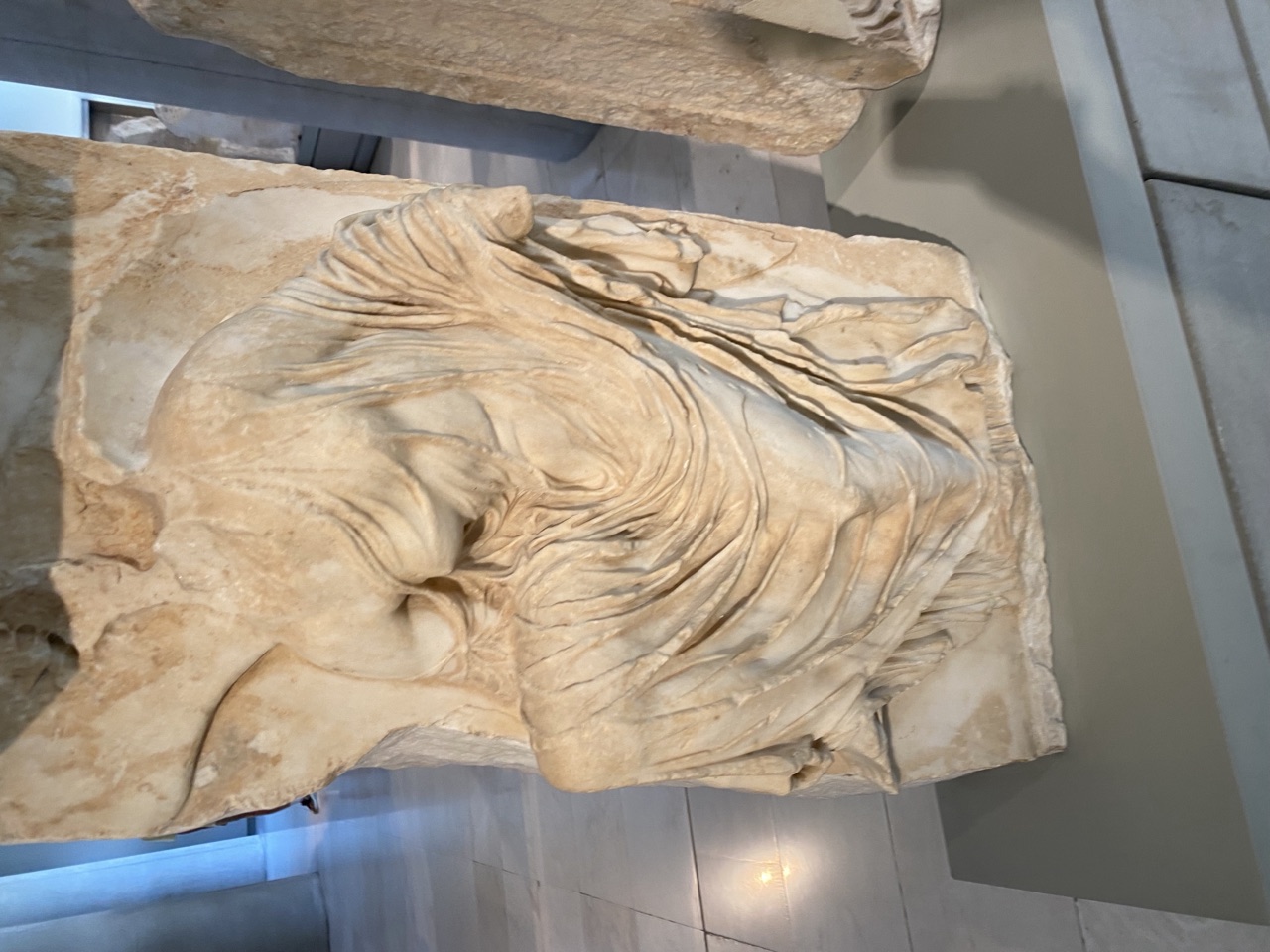
The temple's best-known sculpture is a small relief usually called Nike Adjusting Her Sandal, or the Sandalbinder: a winged Nike bending to unfasten or refasten her sandal, carved in the "wet drapery" style where the marble fabric appears to cling to the body beneath it while the figure stays fully clothed. It came from the parapet that ran around the bastion, not from the temple itself, and it is now held in the Acropolis Museum, off the hill. A visitor who only looks at the temple on the hill will not see it; it is one of the clearer reasons to pair the Acropolis with the Museum and not stop at the rock.
The rest of the temple's sculptural programme, a frieze depicting a battle between Greeks and Persians on one side and an assembly of gods on others, survives only in fragments, several of which are also in the Museum. What you see on the bastion itself today is the architecture: the columns, the small cella, the compact proportions that make it read as a miniature next to the Parthenon uphill from it.
The parapet the Sandalbinder came from was not part of the original temple design. It was added later, a stone balustrade running around the edge of the bastion, both to keep visitors from the drop and to carry a further set of reliefs, mostly other winged Nikes in the same wet-drapery style, leading sacrificial animals or setting up trophies of victory. Fragments of those companion reliefs are scattered between the Acropolis Museum and, in a smaller number of cases, museums outside Greece, part of the same broader dispersal that carried off much of the Parthenon's sculpture in the same period. Seen together in the Museum, the parapet reliefs read as a coherent set: victory, again and again, shown through small domestic gestures such as a figure adjusting her own sandal, with no grand battle scenes.
None of that detail is visible from the bastion itself today, so set your expectations before you go looking for it. What remains on site is the temple's frame: four columns across the front and back, a compact cella barely large enough to have held a single cult statue, and a plinth that puts the whole building above eye level as you pass beneath it on the path up to the Propylaia. Give it a slow look on the way past; a special detour gains you nothing, since there is no way to walk fully around it or get much closer than the path already takes you.
Photo: Melissopetra / Wikimedia Commons
Tickets and where to find it
There is no separate ticket for the Temple of Athena Nike. It sits inside the same Acropolis and Slopes admission that covers the Parthenon, the Propylaia and the Erechtheion, so the booking decision belongs on our main Acropolis tickets page. If you are deciding between a plain ticket and the guided tour, or whether a combo with the Museum is worth it, our Acropolis combo tickets page walks through the options that include this temple as part of the same hilltop admission. A guide is worth having here specifically: the temple's small size means it is easy to walk past without registering what it is, and a two-minute mention on the way to the Propylaia is often the only chance most visitors get to have it pointed out at all. Coming from the Main Entrance and the Beule Gate, the bastion is one of the first things you pass, on your right as you climb toward the Propylaia; coming from the South Slope entrance, it is one of the last things you see before reaching the top. Either route puts it at the start or the end of your visit, so it is easy to walk past quickly on tired legs if you are not looking for it.
Kallikrates, the same architect who worked on the Parthenon, completed it around 420 BC as part of the wider rebuilding of the Acropolis after the Persian destruction of the earlier sanctuaries.
Why has the Temple of Athena Nike been rebuilt so many times?+
The Ottomans dismantled it in 1687 to reinforce a gun emplacement during the Venetian siege. It was reconstructed in 1835-36, again in 1940, and a third time in 2010, each time with more precise knowledge of where the original blocks belonged.
Where is the Nike Adjusting Her Sandal relief?+
In the Acropolis Museum, not on the temple. It came from the parapet that surrounded the bastion, and it is one of the best-known examples of the ancient Greek 'wet drapery' carving style.
Do I need a separate ticket for the Temple of Athena Nike?+
No. It is included in the general Acropolis and Slopes admission, the same ticket that covers the Parthenon, the Propylaia and the Erechtheion.
Where is the Temple of Athena Nike on the Acropolis?+
On a bastion just south-west of the Propylaia, one of the first things you pass from the Main Entrance and Beule Gate, or one of the last from the South Slope entrance.
Is the Temple of Athena Nike the same as the Parthenon?+
No. It is a separate, much smaller Ionic temple dedicated to Athena Nike, goddess of victory, distinct from the larger Doric Parthenon further up the hill.
Do not walk past it this time.
The Temple of Athena Nike is on the same Acropolis and Slopes ticket as everything else on the hill. Book a slot and look right as you climb.
 Bestseller