Four centuries of Greek painting from El Greco onward, back in a rebuilt home on Vasilissis Sofias. The Wednesday late night and what to see.
Tickets and tours
Which ticket to buy
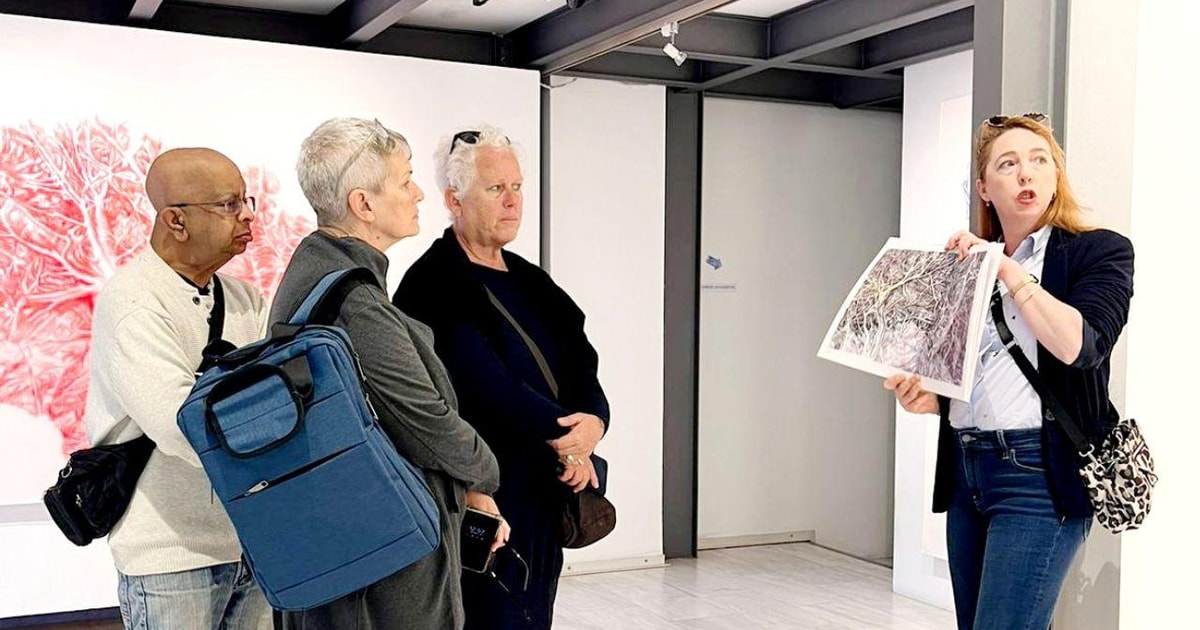
Athens: National Gallery guided tour
★ 5.0 (3)
A guided walk through Greek painting from El Greco to the twentieth century. Useful here because the Munich School and the generation of the thirties are unfamiliar names to most visitors, and the labels assume they are not.
National Gallery Athens: El Greco, the Munich School, and why Wednesday evening is the slot
National Gallery Athens tickets are the simplest purchase on this site, and the cheapest serious art ticket in the city. Entry to the National Gallery - Alexandros Soutsos Museum is free for EU visitors up to 25, and reduced for over-65s and non-EU visitors aged 6 to 25. The one thing worth booking ahead is the guided tour with an art expert, from €28 per person. Admission is a separate line, paid at the gallery on top of the tour price. For a collection whose names are unfamiliar to most visitors, the guided version makes the most sense of it.
What you get for the money is the state collection of Greek painting from the Cretan School to the present, more than 1,000 works on view in a building that closed in 2013 and reopened in spring 2021 with a whole new wing. Three El Grecos have a section of their own, the Munich School portraits fill the 19th-century galleries, and the Generation of the Thirties, Tsarouchis, Ghika and Moralis among them, carry the 20th. In short: come on a Wednesday when the museum stays open until 22:00, take the guided tour if the Greek names on the labels mean nothing to you yet, avoid Tuesday when it is closed, allow about two hours, and walk the five minutes to the Byzantine and Christian Museum afterwards.
Guided tour or plain ticket?
Plain ticket for most visitors, and the guided tour for readers who already know they want the story behind the pictures. The National Gallery Athens guided tour on GetYourGuide is run by a company called Talking Art. It is a live tour in English with an art expert, with time for questions at the end, and it meets at the museum entrance. It costs from €28, can be cancelled up to 24 hours before for a full refund, is listed as wheelchair accessible, and a private-group version is offered for families or small parties. What it does not include is admission, which is settled separately, and the partner page gives no reliable duration, so plan the rest of your day loosely around it. It is a newer listing with only a handful of reviews so far, so judge it on what it includes rather than on a star count.
Who is it for? Anyone for whom names like Gyzis, Lytras, Parthenis and Tsarouchis mean nothing yet. The collection is Greek art told in Greek terms, and the labels assume some knowledge of the country's history: the War of Independence, the Bavarian king, the painters who trained in Munich and came home, the folk painter Theophilos, the generation that tried to be modern and Greek at the same time. A guide turns that sequence into a story in a way a label cannot, and the El Greco section in particular rewards someone explaining what a Cretan icon painter was doing in Venice and Toledo. If you have two hours and that curiosity, the tour is worth its €28.
Who does not need it? Anyone who enjoys walking a well-hung museum at their own pace. The renovated building is laid out in a clear chronological sequence, the sections are signposted by theme, and the works are strong enough to hold their own. The museum's audio-guide app is listed as coming soon on its official page, so do not count on one, but the wall texts are in English. For a solo visit the only decision is which day.
The tour listing uses the phrase skip-the-line entry. Admission is paid separately at the gallery, and there is rarely a queue to skip: unlike the Acropolis, the National Gallery is a museum you walk into on most days.
Tickets and prices
National Gallery Athens prices below are a snapshot from September 2026. The guided tour is a separate purchase on top of admission. The museum's own shop, tickets.nationalgallery.gr, sells dated e-tickets for a chosen day and also offers a couple of combinations worth knowing about, particularly while a temporary exhibition is running.
Ticket
Price
Includes
Guided tour (GetYourGuide, Talking Art)
from €28
Live tour in English with an art expert, questions at the end, meets at the entrance. Admission ticket not included. Free cancellation up to 24 hours before
The reduced ticket goes to visitors aged 6 to 25 from outside the EU, to senior citizens over 65 from Greece or an EU or EEA state, to parents accompanying EU primary-school visits and to teachers escorting school groups from outside the EU. Entry is free for children and young people up to 25 from EU member states, for children under 5 from anywhere, for EU secondary and vocational students visiting with their teachers, for visitors with a disability of 80 percent or more plus one escort, and for ICOM and ICOMOS members. Free tickets are issued online as well, but the supporting document, a passport or ID card, has to be shown at the entrance. Group and school bookings are not made through the e-ticket at all. They go through the museum directly.
The free days are the museum's own list, not the Ministry of Culture calendar that covers the archaeological sites: every first Sunday of the month from 1 November to 31 March, 6 March, 18 April, 18 May and the last weekend of September. Two traps for people who know the state-site rules: 28 October is a closed day here, not a free one, and it is the first Sunday only, not the first and third. Our free museum days in Athens guide lays the different calendars side by side.
The passes do not help. The GetYourGuide Athens City Pass from €79 and its Flex Pass from €60 both leave the National Gallery off their lists, and so does the Headout Turbopass. If you are holding one for the Acropolis and the state museums, it is still a stop of its own, which is a small enough thing that it should not change your plan.
Opening hours and best time to visit
The National Gallery Athens keeps one timetable with no summer and winter split: Monday 10:00 to 18:00, Tuesday closed, Wednesday 10:00 to 22:00, Thursday to Sunday 10:00 to 18:00. Admission ends one hour before closing, so 17:00 on a normal day and 21:00 on Wednesday. The ILISSOS cafe-restaurant keeps the same hours as the galleries. The official page shows no seasonal note against the Wednesday late opening, so treat it as the current schedule and check before you build an evening around it.
Tuesday is the unusual part. Most Athens museums close on Monday. This one is open on Monday and shut on Tuesday, which happens to match the Benaki, the Cycladic and the Goulandris. A Tuesday plan for the museums along Vasilissis Sofias therefore fails at every door, while a Monday is one of the better days to come here, with the crowds elsewhere. The bank-holiday closures are 1 January, 6 January, Clean Monday, 25 March, Orthodox Easter Sunday and Easter Monday, 1 May, Whit Monday, 15 August, 28 October and 25 and 26 December. On Orthodox Good Friday the museum opens from 13:00 to 17:00 only.
The best slot is Wednesday evening. Arriving at 18:00 or 19:00 gives you three quiet hours, the cafe is still open, and the walk back down Vasilissis Sofias to Syntagma is at its pleasantest after dark in summer. On any other day, the first hour after 10:00 is the calm one. A busy temporary exhibition will bring an Athenian weekend crowd, which is the only time the reception hall gets slow. In July and August the building itself is the attraction as much as the pictures: a cool, modern interior with lifts between floors, a few minutes from the metro.
How long to allow: the museum gives no figure. With more than 1,000 works on view across three levels of galleries plus the European painting section, about two hours is a fair plan for a first visit, closer to three if you read everything and stop at the cafe.
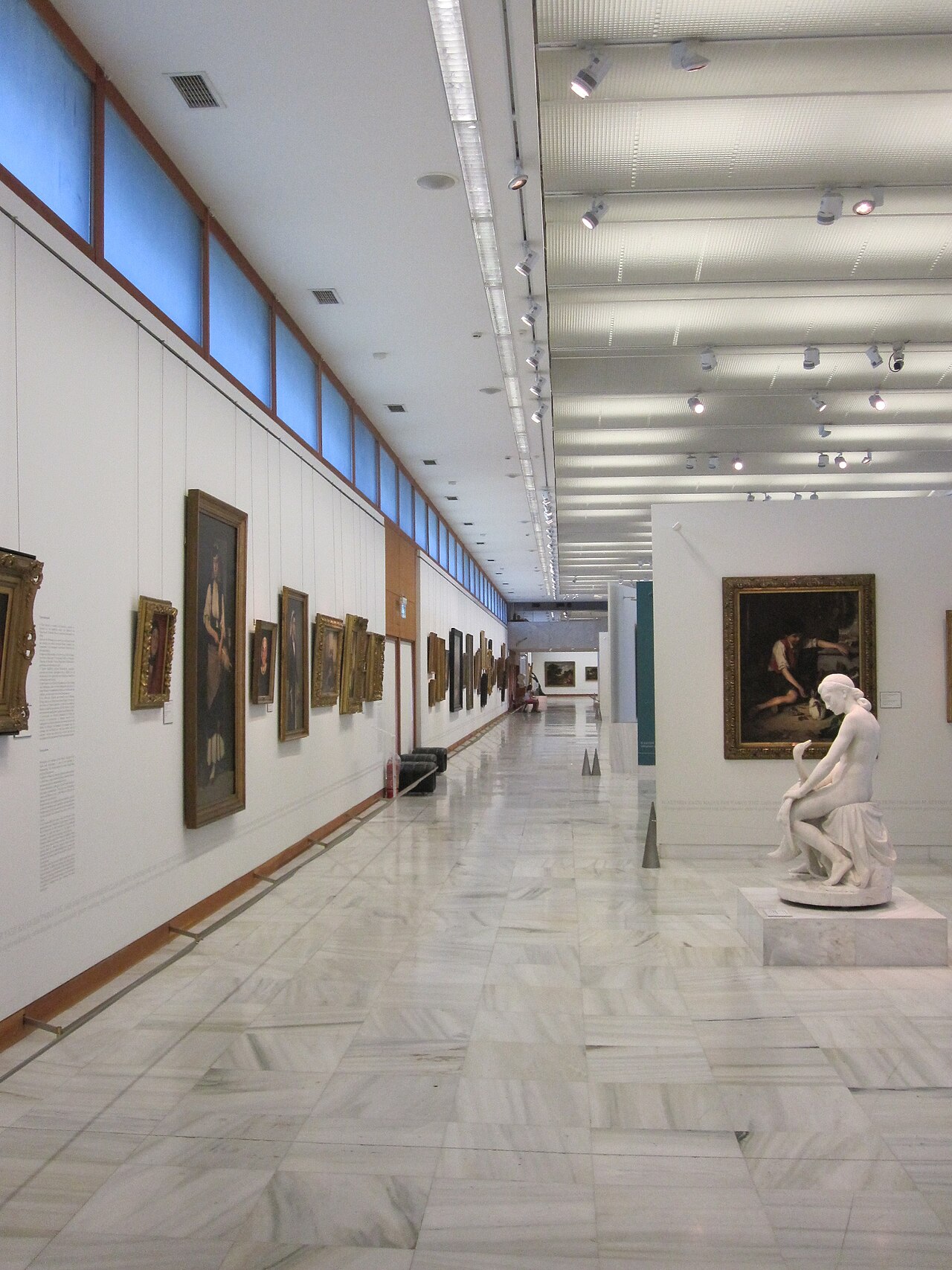
Photo: Matti / Wikimedia Commons
Getting there
The National Gallery Athens stands at 50 Vasileos Konstantinou Avenue, postcode 116 34, on the corner with Michalakopoulou Street. The metro is Line 3, Evangelismos station. From the exit it is about 300 metres, three to five minutes, by our own estimate from the map. Buses 550 and 10 stop at Pinakothiki, which is the Greek for art gallery, right outside. The official page gives 20 minutes on foot from Syntagma Square, most of it along the embassies and museums of Vasilissis Sofias, and there is bicycle parking at the building. Drivers should call ahead for the designated disabled parking. Otherwise leave the car elsewhere.
The neighbours are the reason to give this corner of the city a whole day. The Byzantine and Christian Museum is about five minutes west along Vasilissis Sofias, and its icons are the natural prelude to the Cretan School and El Greco sections here. The Museum of Cycladic Art is about nine minutes, the Goulandris Foundation in Pangrati about 13 and the Benaki main building about 15. The Panathenaic Stadium is roughly 1.1 kilometres south-west along Vasileos Konstantinou, a quarter of an hour on foot, so the gallery also works as the last stop of a stadium-and-National-Garden morning.
What to see: highlights
The El Greco section. Domenicos Theotokopoulos has a room to himself with three works: "The Entombment of Christ", a panel from his Venetian years around 1568 to 1570. "St. Peter", from an apostle series of about 1600 to 1607, and "The Concert of the Angels", the unfinished heavenly half of an Annunciation from his last years, which the museum describes as a precursor of Expressionism. This is the section to see first if time is short.
The Bourgeois Class and Its Painters, 1862 to 1900. The Munich School galleries, built around Nikolaos Gyzis, later a professor at the Munich Academy, and Nikephoros Lytras, whom the museum calls the father of modern Greek painting. Look for Gyzis's "Foster Mother" of 1882 to 1883 and "Artemis Gyzi" of 1890, and for Lytras's full-length "Portrait of Mrs Serpieri" of 1869, nearly two and a half metres tall.
Theophilos and the folk tradition. "The Beautiful Adriana of Athens" of 1930, a guitar-playing woman under a cherry tree with a peacock and a painted red border, hangs in the section on the influence of Kontoglou and Theophilos. The museum's point is that the self-taught painter from Lesbos rejected depth just as the modernists did, and the room makes the case.
Parthenis and the Generation of the Thirties. Konstantinos Parthenis, Vienna-trained and the teacher of Ghika, anchors the room with "Aphrodite". Around him hang Yannis Tsarouchis's "Neon Cafe (Night)" of 1965 to 1966, the Omonia Square cafe painted head-on with a grid the museum compares to Mondrian, and his "Sailor and Cupids" of 1943.
The Ghika gallery and Moralis. Nikos Hadjikyriakos-Ghika has a gallery of his own, with "Memories of Hydra", a large canvas he worked on from 1948 to 1976 and gave to the museum himself. The Yannis Moralis section nearby includes "Summer" of 1968, also a gift from the artist.
European Painting. A smaller section, but it holds Delacroix's "Episode from the Greek War of Independence", the painting that ties the foreign view of Greece to everything else in the building, plus Jan Brueghel II, Cecco del Caravaggio's allegory of the five senses and a Rosalba Carriera portrait. The national tourism board also describes Tetsis's 15-metre "Laiki Agora" triptych in the reception hall and Rodin's "Walking Man" by the entrance.
Tips before you go
Bags go through an X-ray scanner at the entrance and there is a cloakroom with lockers in the main reception hall, so a daypack is no problem but a suitcase is better left at the hotel. The museum publishes no photography rule on its English or Greek pages, so check the signage on the way in. Nothing is published about strollers either. With ramps and lifts to every level, a pram is physically easy, which is the most anyone can say.
Access is good. The official page describes ramps and lifts to all levels, a wheelchair can be borrowed if you reserve it by phone in advance, and designated disabled parking is available by arrangement. The GetYourGuide tour is listed as wheelchair accessible. Free Wi-Fi runs through the building, the shop is in the lobby, and the ILISSOS cafe-restaurant serves drinks, snacks and proper meals for as long as the galleries are open, which on a Wednesday means dinner.
A little context helps the visit. The institution dates from 1900 and grew out of the 1895 bequest of Alexandros Soutsos. The Central Building, by Pavlos Mylonas, Dimitris Fatouros and Nikos Moutsopoulos, opened in 1976, closed for eight years from 2013 and was inaugurated again on 24 March 2021 with a third floor and an underground wing added, 20,760 square metres in all. The whole institution holds around 20,000 works across its annexes. What you see in Athens is the more than 1,000 chosen for the permanent display. The Glyptotheque, the sculpture collection in Goudi, is a separate venue with its own ticket.
One plan: come on a Wednesday at about 18:00, or on a Monday at 10:00 while the rest of the city's museums are shut. Take the combined version if a temporary show interests you, check the cloakroom, and go straight to the El Greco section. Then take the collection in order, the 19th century before the 20th, finishing with Ghika, Moralis and the post-war rooms, and cross to European Painting for the Delacroix on the way out. If you booked the guided tour, meet the guide at the entrance with your ticket already bought, and keep the hour after the tour free for the rooms you want to go back to.
How to book, in four steps
Decide whether you want the guide. If the painters are new to you and you want the story of Greek art from El Greco to the Generation of the Thirties, book the guided tour from €28 and add admission on the day. If you already know your way around a Munich School portrait, admission alone is enough.
Pick the day, and never a Tuesday. Wednesday runs until 22:00 with last admission at 21:00. Every other open day closes at 18:00 with admission until 17:00. Check the holiday list above around Easter, on 1 May, in mid-August and on 28 October, when this museum is closed rather than free.
Book early with free cancellation. The tour can be cancelled up to 24 hours before for a full refund, so reserve it as soon as your Athens dates are fixed and move it if the plan changes. The guided tour is the one thing here worth fixing to a date before you arrive. Reduced and free tickets need the supporting document at the entrance.
Pair it with a neighbour. Start at the Byzantine and Christian Museum five minutes away, then walk to the National Gallery for the Cretan School and El Greco, which pick up where the icons leave off. Or reverse it: gallery in the afternoon, Wednesday dinner at ILISSOS, and the walk down Vasilissis Sofias to Syntagma afterwards.
Nearby and combinations
The National Gallery Athens is the eastern end of the museum row along Vasilissis Sofias, and it pairs most naturally with the collections along that avenue. Our Goulandris Museum tickets page covers the private modern-art collection in Pangrati, about 13 minutes on foot, whose top floor of 20th-century Greek painters, Tsarouchis, Moralis and Ghika among them, overlaps with the rooms here. Seen on the same day, the two museums explain each other. The Byzantine and Christian Museum, five minutes away, is the other obvious partner, and the Cycladic and the Benaki round out a full day on one avenue with no Acropolis queue in sight.
Because the museum is left out of the Athens City Pass and the Flex Pass, treat it as a stop of its own even if you hold a pass for the rest of your trip. The passes still earn their keep at the Acropolis and the big state museums, just not at this door.
For the wider picture, our Best museums in Athens guide ranks the city's collections and suggests which ones pair well in a day. For anyone who arrives thinking of Athens as antiquities only, the National Gallery is the useful correction: three El Grecos, the painters of the new Greek state, and the modern generation that gave the country its own visual language, for €10, on a Wednesday evening, a few minutes from Evangelismos.
How much is admission to the National Gallery of Greece?+
No partner sells a plain entry ticket, so admission is paid at the gallery, through its e-shop or on arrival. A reduced rate applies to non-EU visitors aged 6 to 25, EU and EEA seniors over 65, and teachers escorting non-EU school groups. Entry is free for EU citizens up to 25, non-EU children under 5, disabled visitors with at least 80 percent disability plus an escort, and ICOM members.
Is the National Gallery in Athens free on any day?+
Yes. The gallery publishes its own free-admission list, separate from the Ministry of Culture calendar for the archaeological sites: the first Sunday of the month from November to March, plus 6 March, 18 April, 18 May and the last weekend of September. Outside those dates you pay for admission at the gallery.
What are the National Gallery's opening hours?+
The museum opens Monday from 10:00 to 18:00, Wednesday from 10:00 to 22:00, and Thursday to Sunday from 10:00 to 18:00, with last admission an hour before closing. It is closed on Tuesdays, and on Good Friday it opens only from 13:00 to 17:00.
Is there a guided tour of the National Gallery of Greece?+
Yes, GetYourGuide sells a National Gallery guided tour from €28, though admission is not included and must be bought separately at the museum. There is currently no partner plain-entry ticket for this museum, so the gallery's own e-shop, or the desk on arrival, is the only way to get a ticket alone.
What can you see at the National Gallery of Greece?+
The collection centres on Greek painting, with an El Greco section including The Concert of the Angels and The Entombment of Christ, plus works from the Munich School era and 20th-century Greek painters such as Parthenis, Tsarouchis and Moralis. A European painting gallery adds works by Delacroix and Jan Brueghel the Younger.
How do I get to the National Gallery of Greece?+
The museum is on Vasileos Konstantinou Avenue, close to the Evangelismos metro station on Line 3. Buses 550 and 10 stop nearby at the Pinakothiki stop, and the museum states it is about a 20-minute walk from Syntagma Square, so most visitors combine the metro with a short walk rather than the full route on foot.
El Greco, and four centuries after him.
Four centuries of Greek painting, and labels that assume you know the names. A guided walk is what fixes that.