The Parthenon: what it was built for, what wrecked it, and why it looks different this year
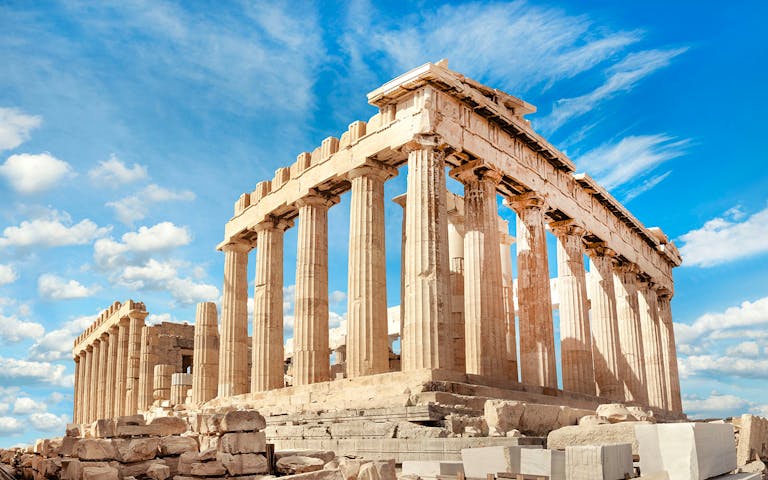
The Parthenon is the temple that everyone pictures when they picture the Acropolis, and for most of the last two centuries it has been pictured half in scaffolding. That changed in 2026: the western facade was fully restored and the external scaffolding came down, leaving the building visible without it for the first time in roughly 200 years. This page covers what the temple was for, what happened to it, and what you are looking at when you stand in front of it.
There is no separate ticket. The Parthenon sits inside the same Acropolis and Slopes admission as everything else on the rock, so the practical booking questions are answered on our main Acropolis tickets page, and what follows is about the building itself.
Built for Athena, 447 to 432 BC
Pericles commissioned the Parthenon as the centrepiece of his rebuilding programme after the Persians had razed the earlier temples on the hill, and it went up fast for its size: fifteen years, 447 to 432 BC. The architects were Iktinos and Kallikrates, with the sculptor Phidias overseeing the decorative programme, and the result is an unusually generous Doric temple, eight columns across each short end and seventeen down each side rather than the more typical six by thirteen, at roughly 69.5 by 30.9 metres. Inside stood Phidias's chryselephantine cult statue of Athena Parthenos, gold and ivory over a wooden core, long since lost; only ancient descriptions and small later copies give any idea of what it looked like.
The building was never a temple in the sense of a place for regular worship. It doubled as the city's treasury, and its sculptural programme, the frieze running around the inner chamber, the metopes on the outer colonnade, the pediment groups at each end, told the story of Athens through myth: the birth of Athena, the contest between Athena and Poseidon for the city, battles between gods and giants, Greeks and Amazons, Lapiths and centaurs. Most of what survives of that programme is not on the building itself any more, which is the next part of the story.
The three tiers of sculpture worked at different scales. Highest up, the pediments at the east and west ends held free-standing marble figures over life size, telling Athena's birth from the head of Zeus on the east and her contest with Poseidon over the city on the west. Below them, 92 carved metopes ran around the outer colonnade in high relief, each one a separate scene: gods against giants on the east, Greeks against Amazons on the west, the sack of Troy on the north, and on the south, Lapiths against centaurs at a wedding feast that turned violent, the best-preserved set today because a mosque wall once protected that side from the 1687 blast. Inside the colonnade, a continuous low-relief frieze ran around the top of the cella wall depicting the Panathenaic procession, the city's own festival for Athena, in a level of narrative detail unusual for a building rather than a standalone sculpture.
The 1687 explosion that left it a ruin
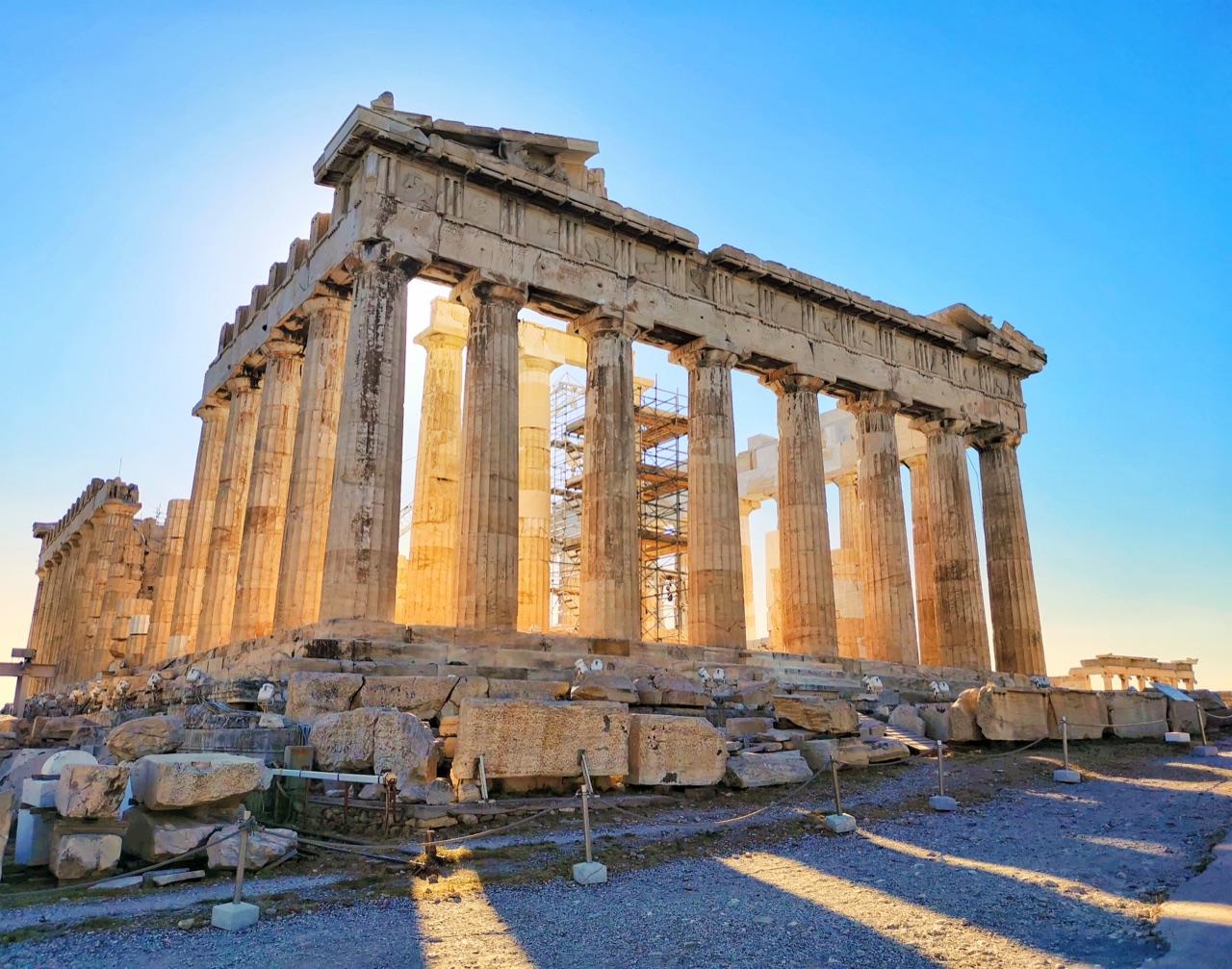
The Parthenon survived largely intact for over two thousand years, converted rather than destroyed: a Christian church dedicated to the Virgin Mary from around the 6th century AD, then a mosque after the Ottoman conquest in the 1460s. That continuity ended on a single night in 1687. During the Venetian siege of Athens under Francesco Morosini, the Ottoman garrison was using the Parthenon to store gunpowder. A mortar shell hit it, and the explosion blew out the roof and much of the interior structure, leaving the shell that stands today. Almost everything visitors now read as "ancient ruin" is "1687 damage": the missing roof, the gap in the colonnade, the fallen sections of frieze.
Photo: Margareths1 / Wikimedia Commons
The Parthenon Marbles: a dispute that is still open
In the early 1800s, with an Ottoman permit of disputed scope, Lord Elgin removed a large portion of the surviving sculptures, roughly half of what remained of the frieze, several metopes and pedimental figures, and shipped them to Britain. They are now held by the British Museum in London and commonly known as the Parthenon Marbles or Elgin Marbles. Greece has campaigned for their return for decades, and it is still going on: the top floor of the Acropolis Museum was purpose-built with the exact layout and orientation of the temple, glass walls facing the Acropolis itself, specifically to display the Marbles together if they are ever returned, with the missing sections currently shown as plaster casts.
Restoration since 1975, and why it looks different now
The Acropolis Restoration Service has worked on the Parthenon since 23 June 1975 under a standing scientific committee, co-funded by Greece and the EU, correcting misplacements from earlier 19th and 20th century interventions and reintegrating scattered original blocks wherever they can be matched back to their place. It is slow, deliberate work: the current phase has already run more than three times as long as it took the ancient Athenians to build the temple in the first place. The visible payoff arrived in 2026, when the western pediment was completed and the external scaffolding came off the building for the first time in about two centuries. A separate, longer project continues inside: partial restoration of the cella, the inner chamber, is expected to take around 15 years and aims to reintegrate about 360 original marble blocks recovered on site, filling gaps with roughly 90 new blocks of Pentelic marble to rebuild sections of wall to between 4.5 and 10 metres high.
The work is not finished. Restoration continues across the wider Acropolis, including the Propylaia, the Erechtheion and the Temple of Athena Nike, under the same committee, so scaffolding elsewhere on the hill in a given season is normal and no sign that anything is wrong.
What to see up close
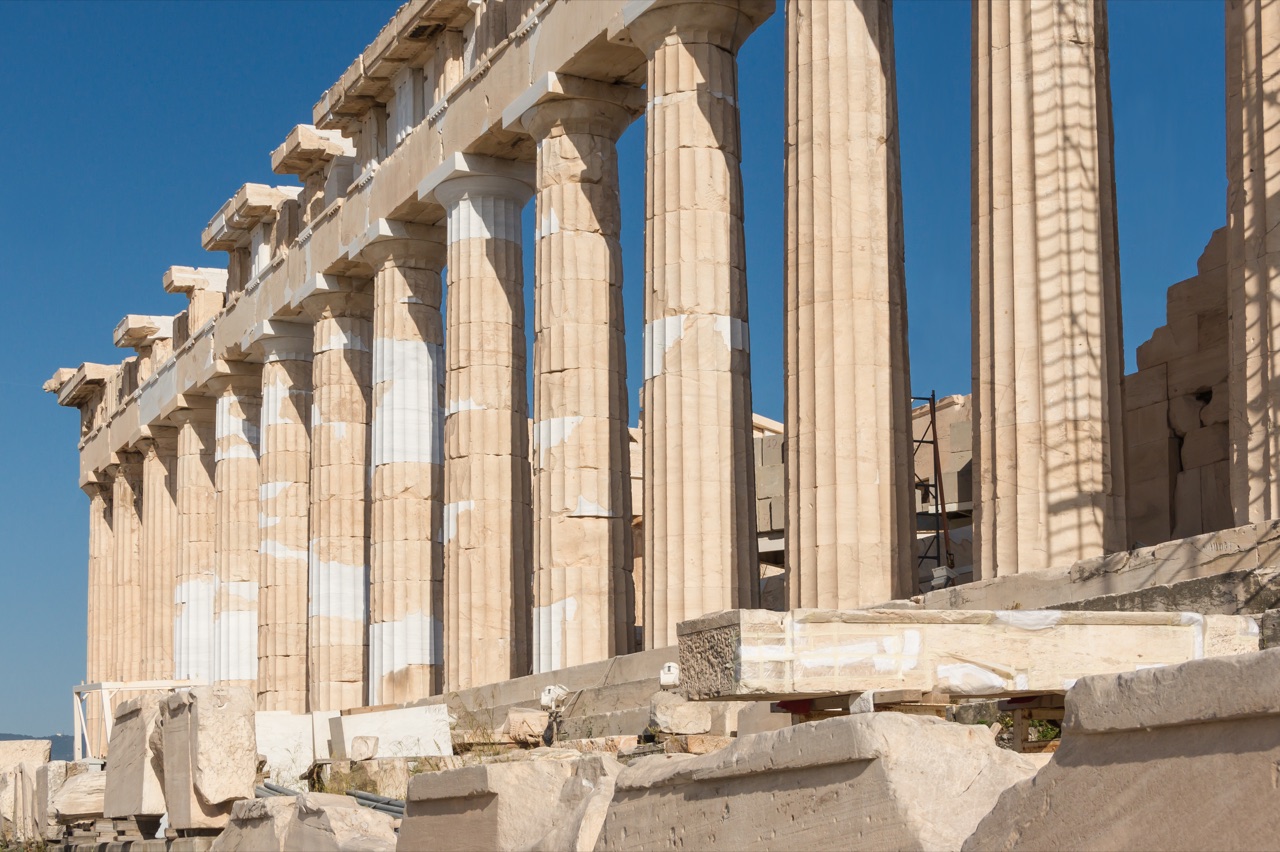
The Doric colonnade. Look for entasis, the very slight outward curve built into the columns to correct an optical illusion that would otherwise make straight columns look concave from a distance.
The frieze fragments still in place. Sections of the original Panathenaic procession frieze remain on the building itself; more, plus casts of the London-held pieces, are in the Acropolis Museum's top-floor gallery.
The 1687 damage. The open roof and the visibly patched colonnade sections are the explosion's mark, not ancient wear.
The restoration joins. Newer Pentelic marble is left visibly lighter than the original weathered stone and is not artificially aged, a deliberate choice so you can tell what is ancient and what is not.
Photo: Jebulon / Wikimedia Commons
Best time to see the restored facade
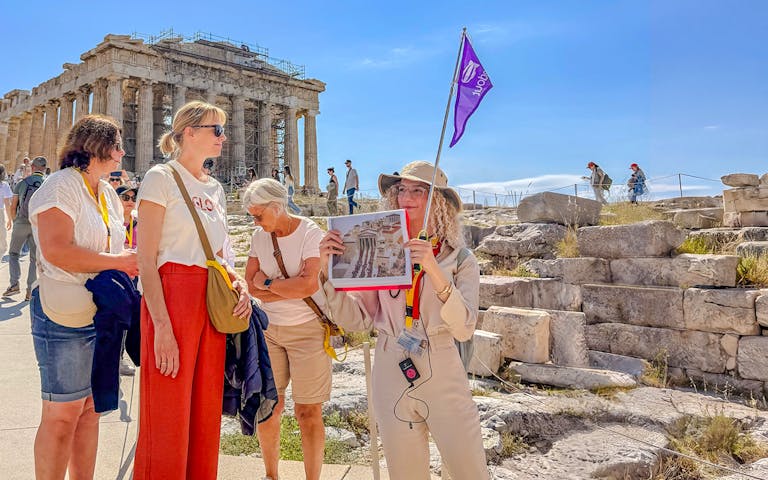
With the scaffolding gone, the western facade, the one most visitors approach first from the Beule Gate, is now visible end to end for photographs that were not possible for most of the last two centuries. Morning light comes from behind the building on this side, so the columns read as a silhouette against the sky rather than showing their surface detail; the warmer late-afternoon light, closer to the last two hours before closing (the seasonal closing times are on the Acropolis opening hours page), picks out the fluting and the marble's colour better. Either way, arrive expecting company: the western approach is the one every guided tour and every other visitor funnels through first, so for a quieter version of this view, stand slightly off to the side of centre.
Tickets and getting there
The Parthenon is inside the Acropolis and Slopes ticket, the same one that covers the Propylaia, the Erechtheion and the South Slope. There is no way to see the Parthenon without an Acropolis ticket, and no separate, cheaper ticket for the building alone. Our Acropolis tickets page has the full price table, the guided-tour-or-plain-ticket decision, and the opening hours. Once you have seen the temple itself, the natural next stop is the Acropolis Museum across the road, where the surviving frieze fragments, the original Karyatides and the purpose-built Marbles gallery fill in everything the ruin on the hill cannot show on its own; if several archaeological sites are on your list, the Acropolis combo tickets page compares the Museum combo and the Athens Multipass side by side.
Mostly because of a single event, not general age. In 1687, during the Venetian siege of Athens, a mortar shell hit the gunpowder the Ottoman garrison was storing inside the building, and the explosion blew out the roof and much of the interior. The temple had survived largely intact for over 2,000 years before that.
Is the Parthenon still under scaffolding?+
The exterior is not: the western facade was fully restored around mid-2026 and the external scaffolding came down, visible without it for the first time in roughly 200 years. A separate, longer restoration of the interior cella continues, and other Acropolis monuments may still carry scaffolding of their own.
Where are the Parthenon Marbles now?+
Roughly half of the surviving sculptures, removed by Lord Elgin in the early 1800s, are held by the British Museum in London. Greece has campaigned for their return for decades; the Acropolis Museum's top floor was purpose-built to display them together with the pieces that remain in Athens if they are ever returned.
Can you buy a separate ticket just for the Parthenon?+
No. The Parthenon is included in the general Acropolis and Slopes admission along with the Propylaia, the Erechtheion and the South Slope. There is no standalone Parthenon ticket.
Who built the Parthenon and when?+
Commissioned by Pericles and built in 447 to 432 BC, with Iktinos and Kallikrates as architects and Phidias overseeing the sculptural programme, including the lost gold-and-ivory statue of Athena Parthenos that stood inside.
What is the difference between the Parthenon and the Acropolis?+
The Acropolis is the whole hilltop site, with several monuments on it. The Parthenon is the largest single building on the Acropolis, its main temple, but not the only one; the Erechtheion and the Temple of Athena Nike stand on the same rock.
See the restored facade for yourself.
The Parthenon sits inside the general Acropolis ticket, not a separate one. Book a slot and see what two centuries of scaffolding used to hide.
 Bestseller