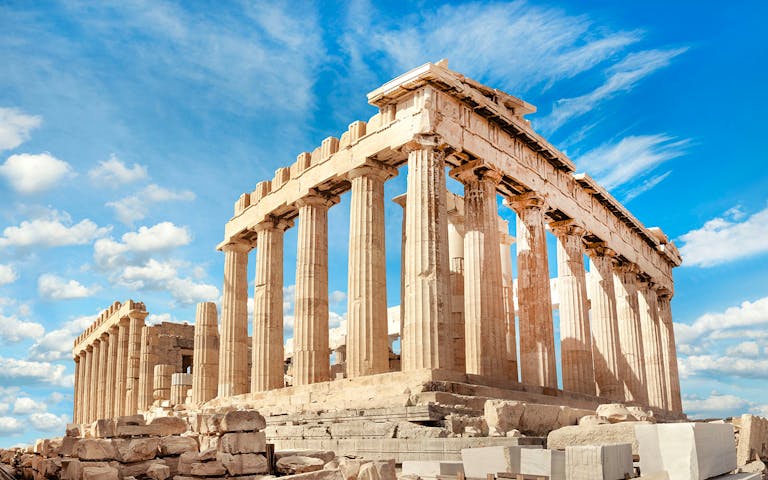
Acropolis map: entrances, layout and how the site connects
An Acropolis map matters more here than at most sites, because the hill has two separate entrances with different starting points, and the monuments spread across a rock large enough that picking the wrong route adds a fair amount of extra walking on uneven ground. Below is where each entrance is, what you see first from each one, and where the highlights sit relative to each other, so you can plan a route before you arrive.
The two entrances
The main entrance sits on the west side of the hill, reached along Dionysiou Areopagitou, the pedestrian avenue that also runs past the Acropolis Museum. This is the entrance almost every guided tour and most independent visitors use, and it puts you at the base of the Propylaia, the monumental gateway, within a few minutes of walking in.
A second entrance serves the South Slope, at the junction of Dionysiou Areopagitou and Thrasyllou Street. This route takes you past the Theatre of Dionysus and the Odeon area before the path climbs to join the main approach below the Propylaia. Both entrances are covered by the same "Acropolis and Slopes" ticket described on the Acropolis tickets page. Neither costs extra or requires a different product, so the choice comes down to the order in which you want to see things.
The site's information centre is at 18-20 Dionysiou Areopagitou, about 50 metres east of the South Slope entrance, useful as a landmark if you are meeting a guide or a tour group before entry. Which of the two to use, and how to plan a one-way route through both, is covered in our guide to each Acropolis entrance.
What you see from the main (west) entrance
Walking in from the west, you pass through the Beule Gate, a Roman-era gate added centuries after the Classical monuments, then climb to the Propylaia itself, the grand Classical entrance built by the architect Mnesikles. Just south of the Propylaia, on a bastion, sits the small Temple of Athena Nike, easy to miss unless you look to your right as you climb. Beyond the Propylaia the path opens onto the main plateau, with the Parthenon dominating the centre-right of the view and the Erechtheion, with its Karyatid porch, on the north side.
What you see from the South Slope entrance
Coming in via Thrasyllou Street puts the Theatre of Dionysus, the ancient theatre built into the hillside, in front of you first, followed by the Odeon area further along the slope. From there the path climbs along the slope and joins the west-entrance route near the top, so you still pass through the Propylaia onto the plateau with the Parthenon and Erechtheion. This route suits visitors who want to see the South Slope monuments without backtracking, or who are arriving from the Acropolis Museum side and prefer not to loop back to the west entrance.
Layout of the main plateau
Once on top, the monuments sit close enough together that there is no wrong direction, but a few relationships are worth knowing. The Parthenon, built under Perikles in the fifth century BC, sits roughly in the centre of the plateau and is the largest structure by far. The Erechtheion is on the north side, facing the Parthenon across an open expanse of rock. Its Karyatid porch, the row of sculpted female figures, faces south toward the Parthenon (the figures on site are copies, the originals are in the Acropolis Museum, one more reason the two sites pair well on the same day). East of the Parthenon stands the base of what was once the Temple of Rome and Augustus, a smaller Roman-era addition. Near the Propylaia at the west end sits the pedestal that once held a statue honouring Agrippa.
No re-entry: pick your route before you go in
Both entrances share one rule that changes how you should plan the map: once you leave the site, your ticket does not let you back in. If you want to see the South Slope theatres and the main plateau in the same visit, walk the whole route in one go and do not step out partway through for a coffee or to swap entrances, since exiting at the Beule Gate or the South Slope gate ends that ticket's use for the day.
Accessibility and the wheelchair lift
The rock itself is reached only from the west side. For visitors using a wheelchair, with reduced mobility, or a parent alone with two or more infants, a lift installed in 2020 rises about 25 metres from a separate entrance north of the Main Entrance, along a 350-metre path, arriving at the plateau near the Erechtheion. Use is accompanied by trained staff, the lift is not available in severe weather or strong wind, and the site asks that wheelchair users phone the guards' office an hour ahead of arrival. Ticket validation and entry for this route happen only at the Main Entrance. On the South Slope itself, the path is accessible for wheelchairs as far as the west side of the Theatre of Dionysus.
What to bring, and site rules
Only small backpacks and handbags are allowed inside. A baggage and stroller check-in point sits just north of the Main Entrance, outside the ticketed area, though it does not accept large luggage, so plan for a day bag only. Site rules ban food, drink and smoking, require visitors to stay on the marked routes and not touch the monuments, and ask for proper walking footwear given the uneven, often slippery marble underfoot.
Toilets inside the site itself are currently closed for renovation. Use the permanent toilets just south of the Main Entrance or the portable toilets to the north, with accessible toilets available at the information centre. A small shop near the entrance runs 08:00 to 19:30 in summer and 08:00 to 17:00 in winter. The separate South Slope shop is closed until further notice.
Walking from the metro
Akropoli station on Metro Line 2 is the closest stop to both entrances. The South Slope entrance is about five minutes on foot from the station along Dionysiou Areopagitou, with the main west entrance a short walk further along the same avenue. Monastiraki station, served by both Line 1 and Line 3, is a slightly longer walk but routes naturally through the Ancient Agora or the Plaka old town on the way, which is worth choosing on purpose if you plan to combine the Acropolis with the Agora or a walk through Plaka.
Heat is worth building into your route on the map as much as the entrances are: the hill has almost no shade, and in extreme conditions the Ministry has shut the site in the middle of the day, as it did during the heatwave in the summer of 2025. Whichever entrance you choose, treat the first two hours after opening or the last two before closing as the more comfortable windows in the warmer months, on top of being the quieter ones described on the opening hours page.
Planning a route around the map
For a first visit with no strong preference, entering from the west (Propylaia first) is the more traditional route and matches how most guided tours are structured, ending your visit near the South Slope theatres as you loop back down. If the Acropolis Museum is later on the same day, the South Slope entrance can work better logistically, since it sits closer to the museum's own entrance on Dionysiou Areopagitou, shortening the walk between the two.
Wherever you start, budget time for the full loop. The Erechtheion's Karyatid porch and the Temple of Athena Nike near the Propylaia are both easy to skip by accident if you beeline to the Parthenon and back, and both deserve a slower look than a photo taken on the way to the main temple.
 Bestseller