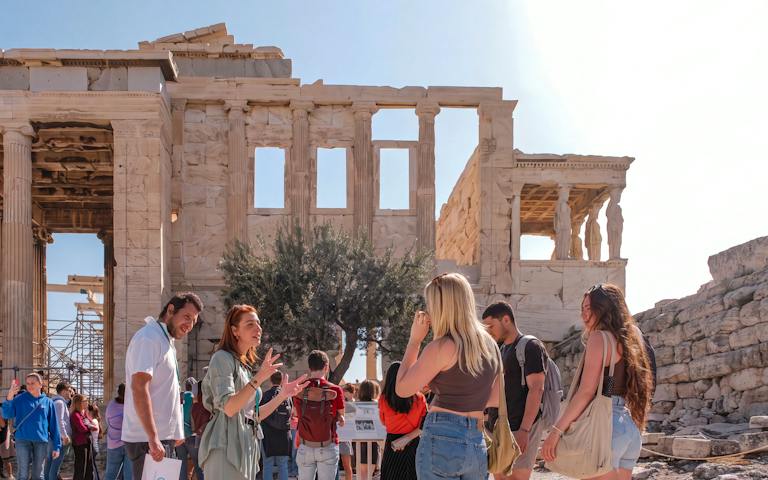
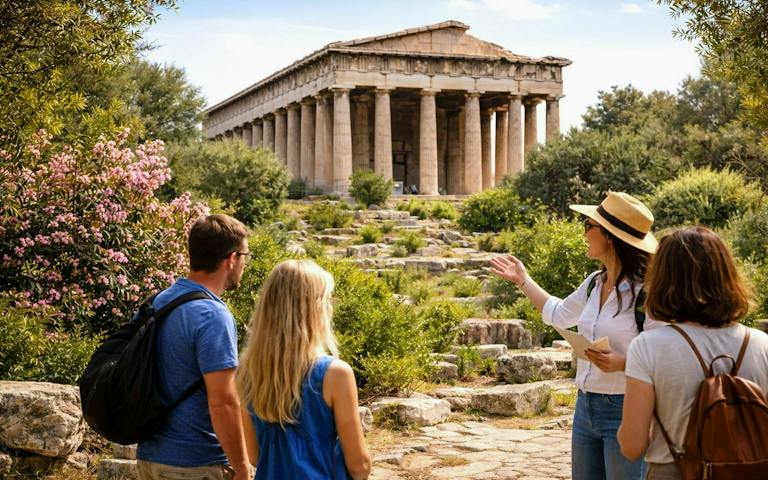
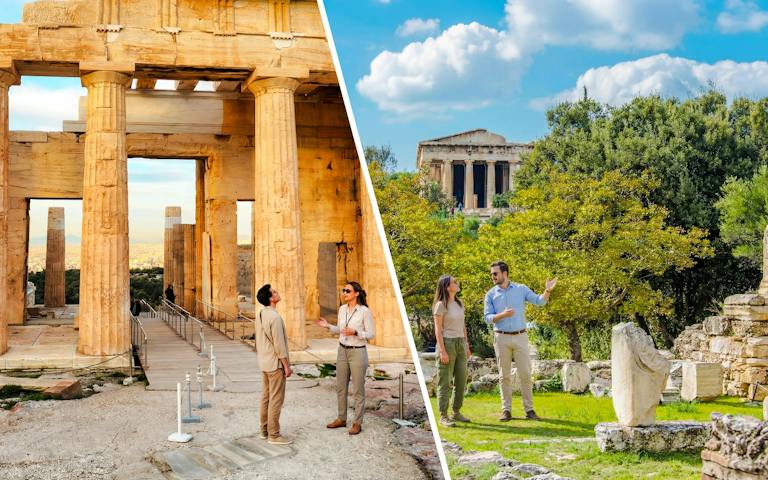
The civic heart of ancient Athens: the Temple of Hephaistos, the rebuilt Stoa of Attalos and the machinery of the first democracy. Which ticket to take and what to see.
Tickets and tours
Which ticket to buy
Ancient Agora Entry Tickets with Audio Guide
★ 4.7 (1,429)
Entry to the site and the Agora Museum with an audio guide, self-paced. The cheapest way to have the place explained, and the Temple of Hephaistos is included at no extra charge.
Ancient Agora Entry Tickets with Optional Audio Guide
★ 4.1 (1,582)
The same entry with a longer audio tour of about 90 minutes to two hours, and the audio left optional. Useful if you want the Stoa of Attalos explained room by room.
Ancient Agora & Roman Agora Combo Ticket with Audio Guide
★ 4.2 (25)
Both agoras in one purchase, about three hours of audio across the two. The Roman Agora is a ten-minute walk east and makes more sense once you have seen what it replaced.
The Roman Agora on its own, with 45 minutes to an hour of audio. The Tower of the Winds stands here, and it cancels free, which the Ancient Agora tickets do not.
Athens: Ancient Agora Guided Tour with Fast-Track Entry
Two hours in the Agora alone with a live guide and fast-track entry. The site is mostly foundations, so a guide is the difference between a field of stones and a working city.
Ancient Agora Athens tickets: the two-agora combo, the audio guide, and which one to buy
Ancient Agora Athens tickets are simpler than the Acropolis ones: one ticket already covers the site and the Agora Museum in the Stoa of Attalos, so the only question is whether you want it narrated. The Headout combo from €44 covers the Ancient Agora and the Roman Agora, a ten-minute walk apart, with a smartphone audio guide for both sites. A plain Headout ticket for the Ancient Agora alone starts from €26 with an audio option, and a two-hour tour with a licensed guide runs from €89. None of the tickets is a skip-the-line product in the Acropolis sense, because the line here is usually short.
Below are the prices, the hours (which step down every fortnight in September and October), the entrance change that catches people out, and what to look at once you are inside. For most visitors: take the combo if you want both agoras in one morning with a narrated walk, the €26 Headout ticket if you want only the temple and the museum with commentary, and the live guide if a two-hour lesson in Athenian democracy is the point of your trip.
Guided tour or plain ticket?
Plain ticket, for most people, and this is one of the few Athens sites where we say that. The Ancient Agora is a large, quiet, mostly open-air site with a temple on a hill, a rebuilt stoa and a lot of foundations in long grass. It rewards context, but the context comes cheaply here: the Headout Ancient Agora Athens tickets include a smartphone audio guide in the combo and offer one as an option on the single ticket, and the Agora Museum labels its democracy exhibits well. The lead product on this page is therefore the Headout Combo Tickets: Ancient Agora and Roman Agora with Audio Guide from €44. It includes entry to the Ancient Agora, the Temple of Hephaistos, the Agora Museum and the Roman Agora, plus an audio guide for both sites with offline text, audio and maps. The audio runs to about three hours across the two sites, and you walk them in whatever order suits you. It is rated 4.2 from 25 reviews at the time of writing, so it is newer and less reviewed than the single ticket.
The guided alternative is the Headout Athens: Ancient Agora Guided Tour with Fast-Track Entry, two hours with a licensed guide, meeting at the Agora entrance, from €89. Its selling point is not the entry, which is easy anyway, but the guide, who can walk you from the boundary stone to the Tholos and explain why a pile of stones was the headquarters of the fifty men running the city that month. If you are the sort of visitor who found the Acropolis frustrating without a guide, this is the product. If you would rather have the Acropolis and the Agora with one guide in one morning, the four-hour Headout combinations from €64 and €105 cover both sites with entry, and unlike the plain tickets they can be cancelled up to 24 hours before.
The caveat that decides it for many readers: the €44 combo cannot be cancelled, only rescheduled up to 24 hours before your slot, and the €26 and €35 single tickets can be neither cancelled nor rescheduled. The €89 guided tour and the Acropolis pairings do have free cancellation up to 24 hours before. So the plain and combo tickets are for fixed dates. The guided products are the ones to book early.
Tickets and prices
Partner prices are a snapshot from September 2026 and can move by a few euros. The partner page shows the live figure before you pay. All Ancient Agora Athens tickets, whoever sells them, are timed: you choose a date and a slot, and Headout allows 15 minutes either side of it. Every ticket includes the Agora Museum, because the Ministry issues one ticket for the site and the museum together.
Ticket
Price
Includes
Ancient Agora and Roman Agora combo with audio guide
from €44
Entry to both agoras, the Temple of Hephaistos and the Agora Museum. Smartphone audio guide for both sites, about 3 hours of audio, offline maps. Cannot be cancelled, can be rescheduled up to 24 hours before
Entry to the Agora, the Temple of Hephaistos and the Church of the Holy Apostles. Options add a three-hour multilingual audio guide or a Plaka audio walk. Cannot be cancelled or rescheduled
A reduced rate applies to the listed categories, verified against ID on arrival. Reduced and free entry is only issued on presentation of documents, so if you qualify, buy at the site rather than from a partner. The Roman Agora is a separate site, and the Headout ticket for it starts from €19 with an audio guide. The maths for the combo is straightforward: it puts both sites, two audio tours and one English booking into a single purchase from €44.
The site is free for everyone on 6 March, 18 April, 18 May, the last weekend of September and 28 October, and on the first Sunday of each month from 1 November to 31 March. On those days a partner ticket buys you only the audio guide.
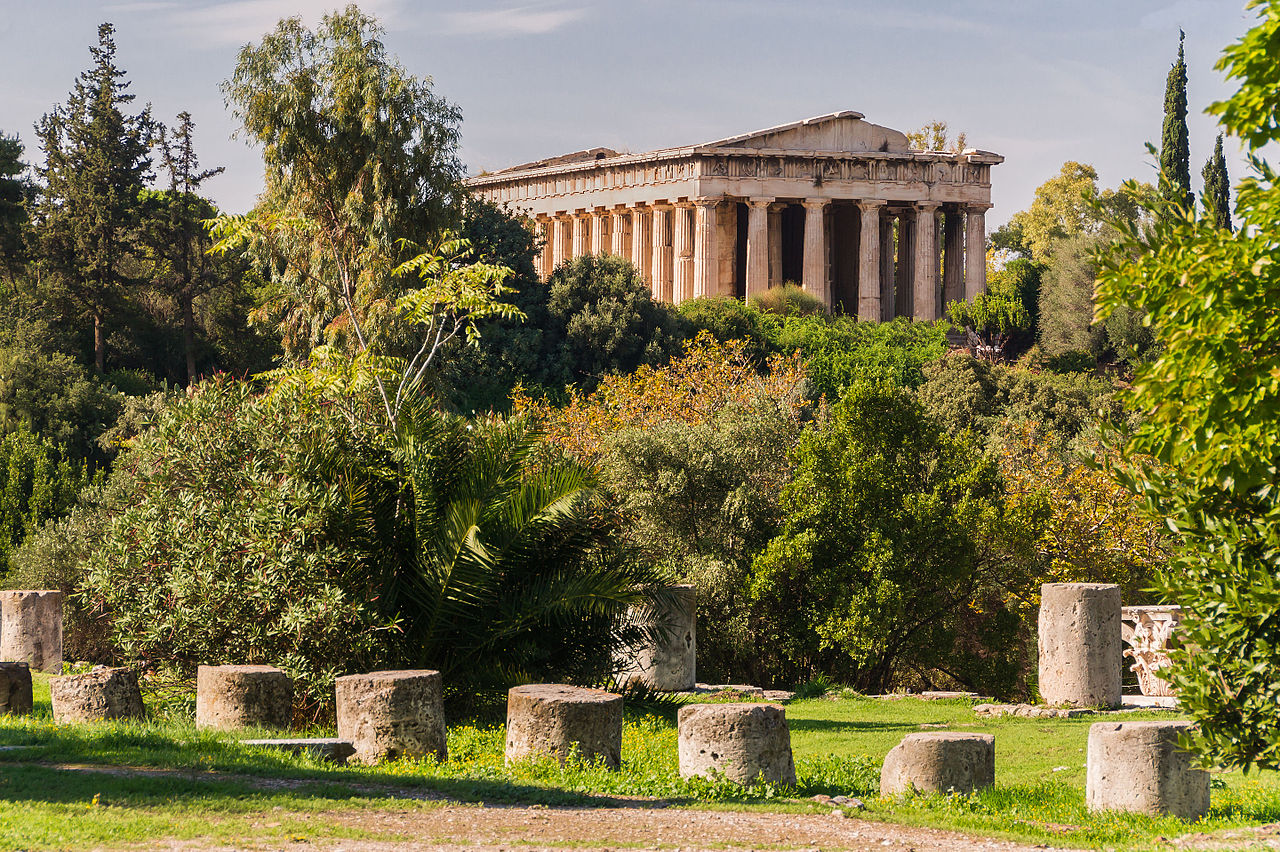
Photo: Jebulon / Wikimedia Commons
Opening hours and best time to visit
The Ancient Agora opens at 8 am every day of the week. There is no weekly closing day. From April to August it closes at 7.30 pm with last entry at 7 pm. Then the hours step down: 1 to 15 September 8 am to 7 pm, 16 to 30 September 8 am to 6.30 pm, 1 to 15 October 8 am to 6 pm, and 16 to 31 October 8 am to 5.30 pm, each with last entry half an hour before closing. From November to March the site runs 8 am to 4.30 pm with last entry at 4.10 pm. The Agora Museum in the Stoa of Attalos follows the site hours but opens at 10 am on Tuesdays, which matters if the kleroterion and the ostraka are the reason you came.
The site is closed on 1 January, 25 March, Orthodox Easter Sunday, 1 May, 25 December and 26 December. On Orthodox Good Friday it opens from noon to 5 pm, and on Holy Saturday from 8.30 am to 3.30 pm. Two things are closed at the time of writing and have been since 1 November 2025: the upper-floor sculpture exhibition in the Stoa of Attalos and the interior of the Church of the Holy Apostles. The Ministry has posted no end date, so plan around the ground floor of the museum and the exterior of the church.
The best time is the first hour after 8 am, in any season. The site is mostly unshaded, the Temple of Hephaistos sits on a rise, and in July and August the walk up from the gate is warm by mid-morning. Early is also when the light is on the temple's east front. Late afternoon works in spring and autumn, but check the last-entry time for your fortnight: a 5 pm arrival is fine in June and right at the last-entry limit in the second half of October. In winter the gate shuts at 4.10 pm, so book Ancient Agora Athens tickets for a morning slot. There is no official figure for how long to allow. Our recommendation is about 1.5 to 2 hours for the site and museum, and closer to three if you add the Roman Agora with the combo's audio.
Getting there
The address is Adrianou 24, 10555 Athens, on the pedestrian street that runs along the north edge of the site between Thissio and Monastiraki. Do not walk to it. Since 1 July 2025 the Adrianou main entrance has been closed for rebuilding, and visitors enter and leave through the gate at Thiseio Square on Apostolou Pavlou Street, the pedestrian avenue on the west side, near Akamantos Street. The Ministry's notice gives no end date, and the Headout product pages describe the same temporary entrance, so head for Thissio rather than Adrianou until you read otherwise.
The nearest metro is Thissio on Line 1, the Piraeus to Kifissia line. The station is a short walk from the gate, and the Kerameikos, the cemetery of ancient Athens, is about ten minutes west along Ermou from the same station if you want a second, far quieter site in the same morning. Monastiraki, the next station along Line 1 and also on Line 3, is one stop and about two minutes from Syntagma, then roughly five minutes on foot through the flea-market streets. Walking from Syntagma Square is about 1.1 km, roughly 15 minutes along Ermou and through Monastiraki. These walking times are our estimates, not official figures.
From the Thiseio gate the west entrance of the Acropolis is about seven to ten minutes uphill along Apostolou Pavlou, which is why the four-hour combination tours pair the two, and why the timing advice on our Acropolis tickets page matters for the same morning. The Herakleidon Museum, with its Antikythera mechanism reconstructions, is about four minutes away on the Thissio side, and the Acropolis Museum about twelve minutes round the south of the rock. The Roman Agora is a ten-minute walk east through Monastiraki, past Hadrian's Library. Its entrance is on Dioskouron Street in Plaka.
What to see: highlights
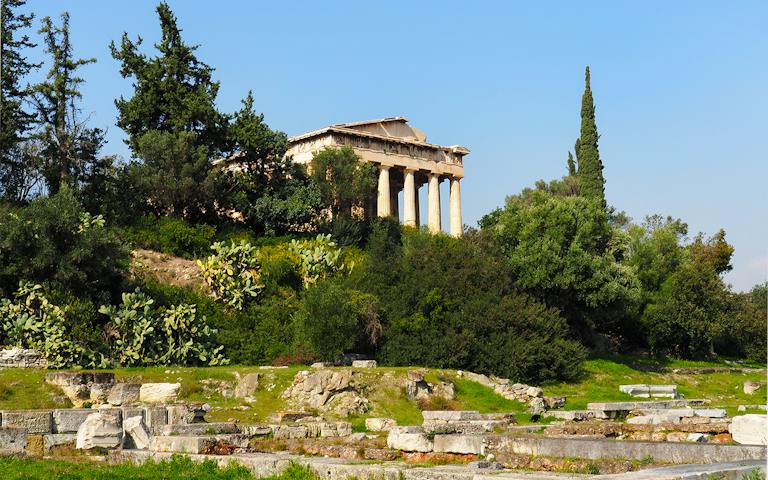
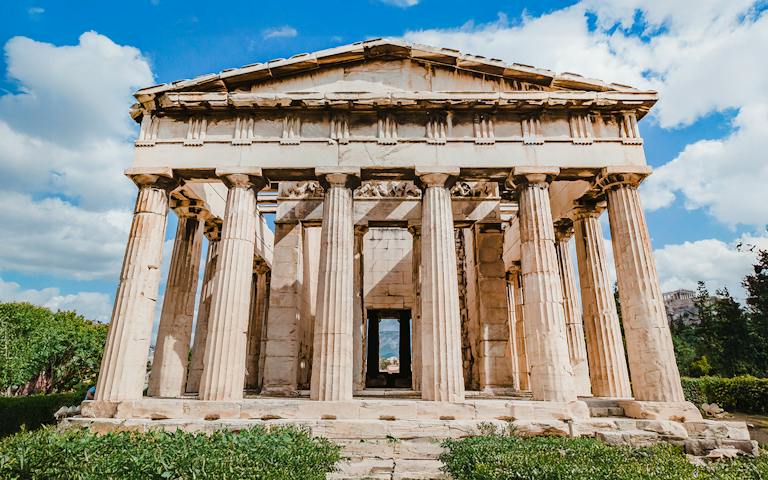
Temple of Hephaistos. On Kolonos Agoraios hill at the west edge of the site, built in the second half of the 5th century BC and dedicated to Hephaistos and Athena Ergane. The Ministry calls it one of the best preserved ancient temples, largely because it spent centuries as a Christian church. The roof was repaired in 1978. It is the one building here that still looks like a building, and the view back across the square from its steps is the best orientation you will get.
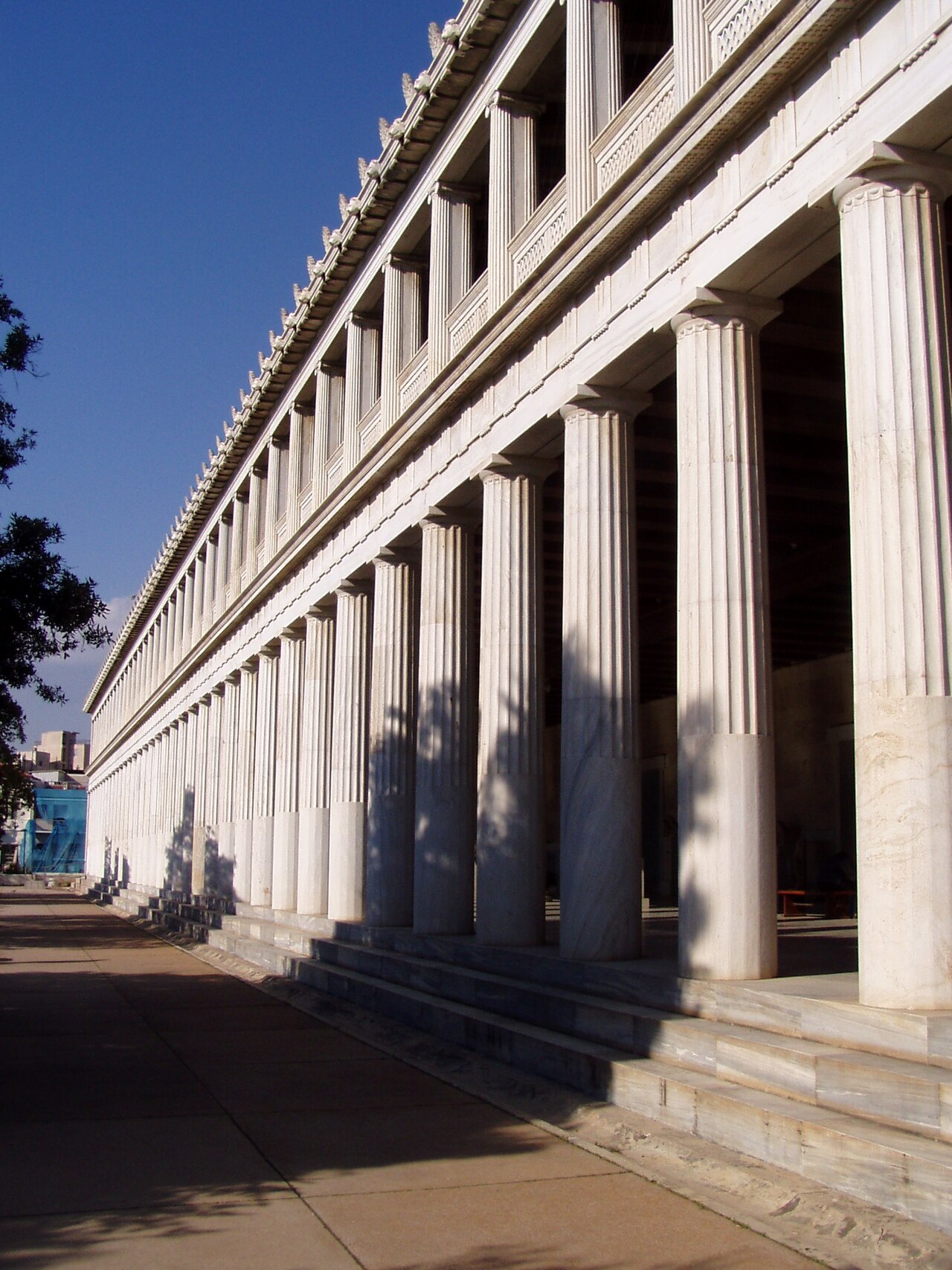
Stoa of Attalos and the Agora Museum. A two-storey colonnade given to the city by King Attalos II of Pergamon in the 2nd century BC and rebuilt in 1953 to 1956 by the American School of Classical Studies to hold the finds. The ground floor is the point: official clay measures and bronze weights, a fragment of a marble kleroterion (the allotment machine that picked jurors by lot), jurors' identification tags, a clay water-clock for timing speeches, bronze ballots, ostraka scratched with the names of 5th-century politicians, and the 336 BC stele showing Demos crowned by Democracy, carrying the law against tyranny. The upper-floor exhibition is closed at the time of writing.
The Giants and Tritons. Four colossal figures that once fronted the Gymnasium built over the Odeion of Agrippa in the middle of the square, restored in the 19th century by the Greek Archaeological Society. They are the site's most photographed fragments after the temple.
Church of the Holy Apostles. A Byzantine church of about AD 1000 at the south-east corner, restored by the American School in the 1950s. Its interior is closed at the time of writing, but the brickwork exterior is still worth the detour.
The democratic core. The Tholos of 470 BC was the headquarters of the fifty prytaneis on duty, the New Bouleuterion housed the Council of 500, the Metroon held the state archive, and the Monument of the Eponymous Heroes of 350 BC was where public notices were posted. Nearby is the boundary stone inscribed "I am the boundary stone of the Agora", beside the house of Simon the cobbler, where Socrates is said to have met his pupils. The so-called Poros Building has been tentatively identified as the State Prison where he was executed.
Panathenaic Way and the Altar of the Twelve Gods. The processional road cuts diagonally across the square towards the Acropolis. The altar of 522 BC beside it was the milestone from which distances from Athens were measured.
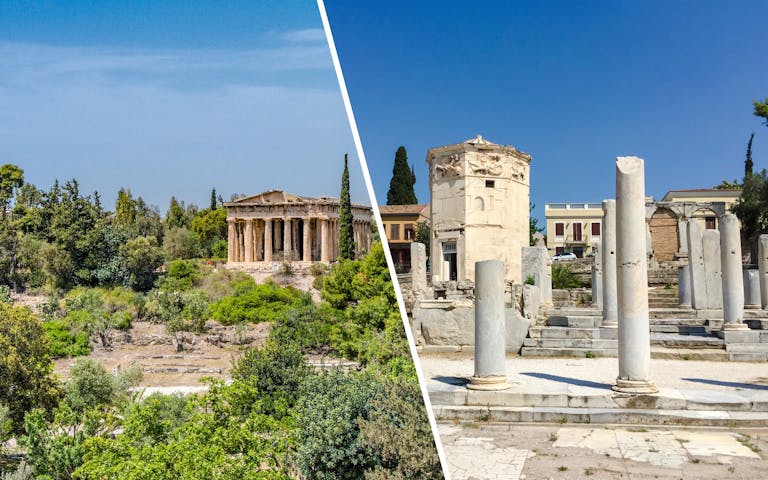
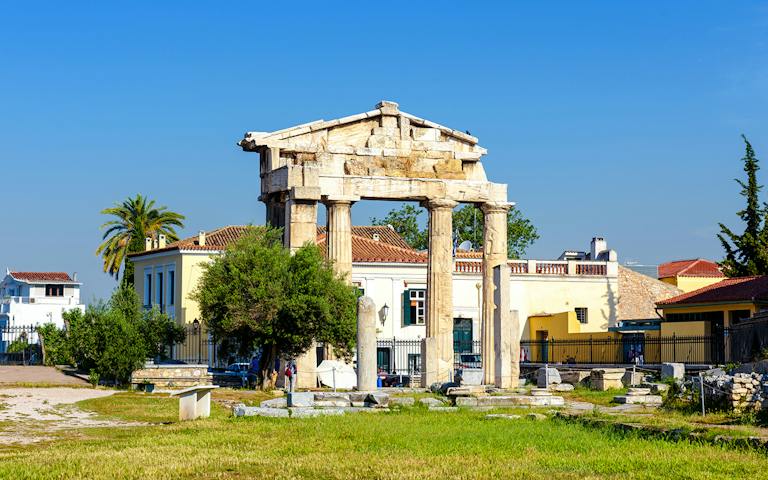
If you took the combo, the Roman Agora is the second half: a courtyard of 111 by 98 metres built between 19 and 11 BC with money from Julius Caesar and Augustus, entered through the Gate of Athena Archegetis with its four Doric columns, with the Fethiye Mosque of 1456 on the north side and 1st-century public latrines in the corner. The Tower of the Winds, the octagonal marble clock tower of the 1st century BC with a wind carved on each face, stands inside the ticketed area. Its interior has been closed under a long-standing notice, so treat it as something to see from outside.
Photo: DerHexer / Wikimedia Commons
Tips before you go
This is an outdoor archaeological site, not a museum with a cloakroom, so wear walking shoes and carry water. The Ministry's rules forbid food and drink, smoking, pets other than assistance dogs, and climbing on or touching the remains, and ask you to keep to the marked routes. Large luggage, professional photo shoots and filming are not permitted. Bring a hat between May and September, because the shade is limited to the Stoa and a few trees along the Panathenaic Way.
Accessibility is better than the terrain suggests. Wheelchair users can reach the Temple of Hephaistos area through the Thiseio Square entrance on Apostolou Pavlou if they phone the site in advance, both levels of the Agora Museum are accessible by lift (ask the guards), there are accessible toilets in the Stoa, and the museum information desk keeps tactile site plans and Braille brochures in Greek and English. Reduced-rate and free visitors should carry ID or the relevant documents. Nothing is issued without them.
A simple plan: book a slot at 8 am or shortly after, enter from Thissio, climb to the Temple of Hephaistos first while it is cool and the light is good, walk down the Panathenaic Way to the democratic buildings on the west side, and finish in the Stoa of Attalos museum, which has the toilets and the shade. Leave by the same gate, walk east to the Roman Agora if you have the combo, and you will be in Plaka in time for lunch. On a Tuesday, reverse it: walk the site first and reach the museum after it opens at 10 am.
How to book, in four steps
Pick combo, plain or guided. Both agoras in one morning with narration: the Headout combo from €44. The Ancient Agora alone: the Headout ticket from €26, which adds the audio guide and an English booking flow. A live guide and a refundable booking: the two-hour tour from €89, or an Acropolis pairing from €64.
Pick the slot. The first slot after 8 am in any season. From mid-September, check the last-entry time for your fortnight before booking an afternoon. In winter, mornings only. Tuesday museum-goers should arrive after 10 am or do the site first.
Book when the dates are fixed. Ancient Agora Athens tickets from Headout are for settled plans: the combo can be rescheduled but not cancelled, and the single tickets can be neither. If your plans might change, the guided products carry free cancellation up to 24 hours before, which is worth the difference in price to some travellers.
Pair it with a neighbour. The Roman Agora is the natural second stop and the combo already covers it. The Acropolis is seven to ten minutes uphill from the gate, and the Herakleidon Museum is four minutes away for a rainy hour.
Nearby and combinations
The obvious pairing is the Acropolis. The four-hour Headout tours from €64 and €105, described above, make sense if you would otherwise book the Acropolis guided tour: the Agora becomes a modest add-on with the same guide and a downhill walk between the two. Our Acropolis page sets out the timed-entry rules and the queue reality that make the early slot on the rock non-negotiable in summer.
If the Agora is one of several state sites on your list, the Athens City Pass is worth a look, with one important caveat: the Headout MegaPass does not include the Ancient Agora or the Roman Agora, while the Turbopass does, alongside the Acropolis, the Acropolis Museum and the hop-on hop-off bus. Read the inclusions before you assume the Agora is covered. For single-site value, remember that the free days above apply to everyone.
For a same-day walk on the far side of the old town, Temple of Olympian Zeus tickets are another Ministry single-site product, and the temple lies about twenty minutes east of the Agora through Plaka. Closer to hand, Hadrian's Library at Monastiraki is a separate site you will pass on the way to the Roman Agora, and it is quiet enough that many visitors have it to themselves.
Partner tickets with an audio guide start from €26, and the combo covering both the Ancient Agora and the Roman Agora runs from €44. One ticket covers the archaeological site and the Agora Museum in the Stoa of Attalos together, and the Temple of Hephaistos is included at no extra charge.
Where is the entrance to the Ancient Agora?+
At the Thiseio Square gate on Apostolou Pavlou Street. Since 1 July 2025 that gate is the only way in and out while the main Adrianou Street entrance is being rebuilt, so the Adrianou address still on most maps will not get you in. Thissio station on Line 1 is the closest metro, and Monastiraki on Lines 1 and 3 is a few minutes further.
What time does the Ancient Agora open?+
08:00, every day, with no weekly closing day. Closing moves with the season: 19:30 from April to August, then 19:00 in early September, 18:30 in late September, 18:00 and 17:30 through October, and 16:30 from November to March, with last entry about 20 minutes earlier. The Agora Museum in the Stoa of Attalos opens at 10:00 on Tuesdays.
Is the Temple of Hephaistos inside the Ancient Agora?+
Yes. It stands on the Kolonos Agoraios hill inside the site and is covered by the same ticket, with no separate charge. Built in the fifth century BC, it is one of the best preserved ancient Greek temples anywhere, largely because it served as a church for centuries.
Is the Ancient Agora worth visiting after the Acropolis?+
Yes, and it is about seven minutes' walk from the Acropolis Main Entrance. The Acropolis was the sanctuary. The Agora was the working city, where the assembly met, juries were drawn and Socrates argued. The Agora Museum holds the objects that make that concrete: the kleroterion fragment used to pick jurors, ostraka, bronze ballots and the stele of Demos crowned by Democracy from 336 BC.
Are parts of the Ancient Agora closed?+
Yes, two of them. The upper floor of the Stoa of Attalos and the Church of the Holy Apostles have been closed since 1 November 2025, and the Adrianou entrance is a building site. The ground-floor museum, the Temple of Hephaistos and the rest of the site are open as normal.
The city the Acropolis looked down on.
Site and museum together, seven minutes from the Acropolis Main Entrance. Book the audio or the guide before you walk over.